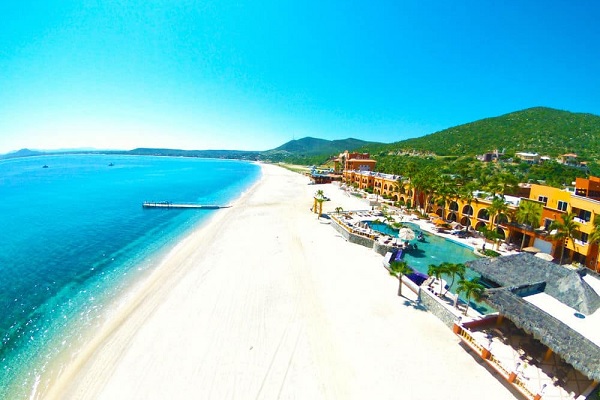
Cabo Pulmo real estate is anti-Cabo. No infinity pools, no branded residences, no concierge. This is North America's oldest living coral reef, a UNESCO World Heritage Site where fish biomass has surged 463% since the community banned fishing. If you are looking here, you already know what you want — and it is not a resort lifestyle.
Key Takeaways
- UNESCO World Heritage Site since 2005 — over 400 species, 463% fish biomass increase since fishing ban
- In March 2026, PROFEPA shut down 6 nearby developments for lacking environmental impact authorizations
- Off-grid properties common: solar power, water cisterns, septic — limited infrastructure by design
- 2 hours from SJD airport; no public transit, no hotel chains, no gas stations
- Properties retain value because development is permanently constrained by environmental protections
Interested in East Cape and Conservation Properties?
We know every pocket of the East Cape. Let us help you find a property that aligns with your values and your budget.
Explore East Cape PropertiesWhy Cabo Pulmo Matters
I have walked a lot of coastline in Baja. Cabo Pulmo is different from every other stretch. The reef here is roughly 20,000 years old — the only living coral reef in the Sea of Cortez and the oldest on the Pacific coast of North America. In the 1990s, the local fishing community made a decision that changed everything: they stopped fishing. Voluntarily. They bet their livelihoods on conservation and eco-tourism instead.
That bet paid off. By 2009, scientists documented a 463% increase in fish biomass — one of the most dramatic marine recoveries ever recorded. The reef now hosts over 400 species, from bull sharks to whale sharks, manta rays to sea turtles. Jacques Cousteau called the Sea of Cortez "the world's aquarium." Cabo Pulmo is the exhibit that proved him right.
In 2005, UNESCO designated the area as part of the Islands and Protected Areas of the Gulf of California World Heritage Site. That designation is permanent and carries international legal weight. This is not a temporary moratorium — it is a global commitment to preservation.
What the Real Estate Actually Looks Like
If you are coming from the Cabo San Lucas market, reset your expectations completely. Cabo Pulmo real estate is:
- Low-density. We are talking individual lots and small casitas, not condo towers or master-planned communities.
- Off-grid. Most properties run on solar panels with battery storage. Water comes from cisterns or wells. Septic systems, not sewers.
- Modest in scale. The biggest homes here would be guest houses in Pedregal. That is the point.
- Conservation-first. Building permits — when they are available — come with environmental impact requirements that are serious and enforced.
Price ranges as of mid-2026:
- Undeveloped lots: $150,000 to $300,000 depending on size, proximity to the coast, and road access.
- Completed off-grid homes: $350,000 to $600,000+.
- Small eco-casitas: $200,000 to $400,000.
The inventory is tiny. At any given time, there may be fewer than 20 properties actively listed in the broader Cabo Pulmo area. This is not a market where you browse — it is a market where you wait for the right property and move fast when it appears.
The 2026 PROFEPA Crackdown: What Buyers Need to Know
In March 2026, Mexico's Federal Environmental Protection Agency (PROFEPA) shut down 6 real estate developments near Cabo Pulmo for operating without proper environmental impact authorizations — the MIA (Manifestacion de Impacto Ambiental). This was not a warning. These were active shutdowns.
What this means for buyers:
- Verify environmental compliance before you buy. Any property near Cabo Pulmo should have a valid MIA on file. Your attorney should pull this documentation as part of due diligence. If the seller cannot produce it, walk away.
- Understand that "near Cabo Pulmo" is loosely defined. The buffer zones around the national park extend further than most maps show. A property 10 kilometers from the reef boundary can still fall under heightened environmental scrutiny.
- Expect enforcement to continue. The PROFEPA action signals a federal commitment to protecting this area. Any new development without proper permits is at risk of shutdown, which means your investment is at risk if the developer cut corners.
This is actually good news for legitimate buyers. Enforcement keeps the supply constrained, which protects property values. But it means you need a lawyer who knows the environmental regulatory landscape, not just the real estate transaction side.
Want to Buy on the East Cape?
The East Cape has properties from Cabo Pulmo to Costa Palmas. Let us match you with the right community for your goals.
Book a Free CallThe Eco-Tourism Economy
Cabo Pulmo's economy runs on eco-tourism, and it is not small. Mexico's eco-tourism sector generates approximately 50 billion pesos annually, and Cabo Pulmo is one of the flagship destinations driving that number. The activities that bring visitors here:
- Diving and snorkeling: The reef is the main attraction. Visibility regularly exceeds 20 meters, and the marine life density rivals anywhere in the world.
- Whale shark encounters: Seasonal (October through March), with operators running responsible, permitted tours.
- Kayaking and paddleboarding: The calm waters of the bay are ideal for non-motorized water sports.
- Hiking: The surrounding desert landscape offers trails through cardón cactus forests with coastline views.
The no-hotel-chain policy is enforced by the community, not just by regulation. Cabo Pulmo residents — many of whom are descendants of the original fishing families — have consistently opposed large-scale tourism development. The most famous fight: the 2012 defeat of the proposed Cabo Cortes mega-development (Hansa Urbana), which would have built 30,000 hotel rooms on the coastline. The community, backed by international environmental organizations, got the project cancelled. The Cabo Pulmo National Park website has current visitor information and dive operator listings.
Living Off-Grid: The Practical Reality
If you are seriously considering Cabo Pulmo, you need to understand what off-grid living actually means in day-to-day terms. This is not glamping — it is infrastructure management.
Power: Most properties run 100% solar with lithium or lead-acid battery banks. A well-designed system for a modest home costs $15,000 to $30,000 USD and provides reliable power for lights, refrigeration, fans, and charging. Running air conditioning requires a significantly larger (and more expensive) system. Some homeowners use propane generators as backup during cloudy stretches or high-demand periods.
Water: There is no municipal water. You will either collect rainwater (limited — BCS gets roughly 7 inches of rain per year), have water trucked in to a cistern (pipa delivery, roughly $50-80 per truckload), or drill a well with a CONAGUA permit. Water conservation is not a lifestyle choice here — it is a necessity. Low-flow fixtures, greywater recycling, and drought-tolerant landscaping are standard.
Internet: Starlink has been a game-changer for remote coastal Baja. Before satellite internet, Cabo Pulmo had essentially no connectivity. Now, $120/month gets you 50-100 Mbps — enough for video calls and streaming, though not always reliably. If your livelihood depends on consistent internet, have a cellular hotspot as backup.
Waste: Septic systems, maintained by the homeowner. There is no waste collection service. You manage your own trash removal — recycling goes to the nearest town (La Ribera), and organic waste is composted locally.
Medical: The nearest clinic is in La Ribera (30 minutes). Serious medical issues require a 2-hour drive to San Jose del Cabo. If this makes you uncomfortable, factor it into your decision honestly.
The Investment Thesis: Scarcity as a Moat
Cabo Pulmo real estate does not appreciate the same way conventional markets do. You will not see 15% year-over-year price jumps driven by new development and speculation. Instead, the value thesis is built on permanent scarcity.
Here is why that matters:
- No new supply is coming. Environmental protections ensure that the number of properties near Cabo Pulmo will not meaningfully increase. Ever. That is the opposite of markets like Cabo San Lucas where new towers go up annually.
- Demand is growing. The eco-tourism and conservation real estate market is expanding globally as more buyers prioritize environmental values. The pool of buyers who want what Cabo Pulmo offers gets larger every year.
- UNESCO designation is permanent. This is not a local zoning decision that a new mayor can reverse. International protections carry diplomatic and legal weight.
- The reef itself is the amenity. A 463% increase in marine biomass is not a marketing claim — it is a measured, published scientific result from the Scripps Institution of Oceanography and other research institutions. The reef gets healthier over time, which makes the location more valuable over time.
The trade-off: liquidity. When you decide to sell, the buyer pool is small. You may wait months or even a year to find the right buyer at your price. This is not a flip market. It is a hold-and-live-in market. If you need the ability to sell quickly, buy in Cabo San Lucas where transaction volume is measured in hundreds per quarter, not single digits per year.
East Cape Alternatives With More Infrastructure
If the Cabo Pulmo lifestyle appeals to you but the off-grid reality is too raw, the broader East Cape offers a spectrum of options:
- Los Barriles: A functioning town with grocery stores, restaurants, a growing expat community, and properties from $200K to $1M+. Still feels remote but has grid power and municipal water.
- Zacatitos: Between Los Barriles and Cabo Pulmo, with slightly more infrastructure than Pulmo but still very low-key. Custom homes on large lots.
- Costa Palmas: The opposite end of the East Cape spectrum — a fully master-planned luxury community with a Four Seasons, Amanvari, Robert Trent Jones II golf course, marina, and residences from $1.5M to $30M+. This is the East Cape for people who want services.
Who Actually Buys Here
Cabo Pulmo buyers are a specific type. After years of working with people exploring this area, here is the profile:
- Marine biologists, divers, and conservation professionals who want to live near the reef.
- Off-grid enthusiasts who see solar panels and cisterns as features, not limitations.
- Artists and writers seeking isolation and natural beauty as creative fuel.
- Investors with a 20-year horizon who understand that scarcity-driven value appreciation works differently than market-driven appreciation.
- Retirees who are done with resorts and want something raw and real.
Who should not buy here: anyone who needs reliable internet for daily work calls, anyone who wants a gym or pool, anyone who gets anxious when the road is unpaved, or anyone whose exit strategy is "sell within 3 years." This market is illiquid by nature. When you buy in Cabo Pulmo, you are buying a lifestyle commitment.
Due Diligence Checklist for Cabo Pulmo Properties
Because of the heightened environmental sensitivity, your due diligence here goes beyond the standard Cabo buying process:
- Verify the MIA. The Manifestacion de Impacto Ambiental must be current and approved by SEMARNAT. No MIA, no purchase.
- Confirm water rights. Wells in this area require CONAGUA permits. An unpermitted well can be shut down.
- Assess solar capacity. How many panels, what battery storage, what is the realistic daily output? Cabo Pulmo gets excellent sun year-round, but an undersized system means running a generator.
- Inspect road access. Some properties require 4WD to access during rainy season (August-October). Know what you are getting into.
- Review the fideicomiso terms. Standard for any coastal property purchase — this is within 50 km of the coast.
- Talk to the community. Cabo Pulmo is small enough that your neighbors will know your property history better than any title search.
Explore East Cape Real Estate
From off-grid Cabo Pulmo to luxury Costa Palmas — the East Cape has something for every buyer who values nature. Let us find yours.
Contact Our East Cape TeamFrequently Asked Questions
Can you buy real estate near Cabo Pulmo?+
Yes, you can buy property near Cabo Pulmo, but options are extremely limited by design. The national park itself has no development. Surrounding areas have low-density, conservation-minded inventory including off-grid homes, eco-lots, and small casitas. In March 2026, PROFEPA shut down 6 real estate developments near Cabo Pulmo for lacking environmental impact authorizations, so buyers must verify that any property has proper MIA (Manifestacion de Impacto Ambiental) approval.
Why is Cabo Pulmo a UNESCO World Heritage Site?+
Cabo Pulmo was designated a UNESCO World Heritage Site in 2005 as part of the Islands and Protected Areas of the Gulf of California. It contains North America's oldest living coral reef, over 400 marine species, and has experienced a 463% increase in fish biomass since the local fishing community voluntarily banned fishing in the 1990s. It is considered one of the most successful marine conservation stories in the world.
How far is Cabo Pulmo from San Jose del Cabo airport?+
Cabo Pulmo is approximately 2 hours by car from the San Jose del Cabo International Airport (SJD). The drive follows Highway 1 south to La Ribera, then a partially paved road east to the coast. The last stretch is unpaved. There is no public transportation to Cabo Pulmo — a rental car or private transfer is necessary.
Is there infrastructure at Cabo Pulmo?+
Infrastructure at Cabo Pulmo is intentionally limited. There is no municipal water system, no sewer, and limited electrical grid access. Most properties rely on solar power, water cisterns or wells, and septic systems. There are no major hotel chains, no gas stations, and only a handful of small restaurants and dive shops. This is by design — the community prioritizes conservation over development.
What happened with PROFEPA shutting down developments near Cabo Pulmo?+
In March 2026, Mexico's Federal Environmental Protection Agency (PROFEPA) shut down 6 real estate developments in the Cabo Pulmo area for operating without proper environmental impact authorizations (MIA). This enforcement action signals that Mexico is serious about protecting the national park's buffer zones. Buyers should ensure any property near Cabo Pulmo has full environmental compliance documentation before purchasing.
What kind of properties are available near Cabo Pulmo?+
Properties near Cabo Pulmo are typically small-scale: off-grid casitas, eco-lots for custom builds, and modest homes designed for low environmental impact. You will not find luxury condos or resort-style developments here. Prices range from $150,000 for undeveloped lots to $500,000+ for completed off-grid homes. The market is tiny compared to Cabo San Lucas or the Corridor.
Is Cabo Pulmo real estate a good investment?+
Cabo Pulmo real estate holds value precisely because development is permanently restricted. You are not competing against a pipeline of new condo towers. Supply is structurally constrained by environmental protections that are unlikely to be loosened. For buyers seeking conservation-aligned investment with scarcity value, it is compelling. For those seeking rental income or liquidity, the market is too small and remote.

Aaron Cuha
Real Estate Advisor & Los Cabos Market Expert
Real estate advisor and founder of Living In Cabo. 15+ years helping families navigate complex real estate decisions. Strategic partner with Ronival — Baja's largest brokerage.