Turks and Caicos has no property taxes and no capital gains tax. Los Cabos has both. And Cabo is still the better buy for most American and Canadian buyers in 2026. Here's why the headline number isn't the full story.
Key Takeaways
- TCI median 2-bed home: $995K; Cabo median condo: $450K-$550K — 2.5-3x price gap
- TCI stamp duty: 6.5-10% at closing; Cabo closing costs: 4-6% total
- Cabo rental yields: 6-10% gross vs. TCI: 4-7% gross
- TCI: zero property tax and zero capital gains; Cabo: 0.1-0.3% predial + capital gains
- Cabo has 30+ direct US/CA flight routes; TCI has ~10 seasonal routes
Comparing Cabo to Caribbean Markets?
I've helped buyers who were torn between Cabo and the Caribbean make the right call. Let me walk you through the numbers for your situation.
Contact MeThe Price Gap Is the Story
I get asked about Turks and Caicos at least once a month by buyers who see the "zero tax" headline and want to compare. Fair enough — TCI is gorgeous, the beaches are world-class, and the tax structure looks unbeatable on paper. But the actual purchase math tells a different story for most buyers in my pipeline.
As of mid-2025, the median price for a two-bedroom home in Turks and Caicos is $995,000. The average condo sale price is approximately $1.4 million. The median price per square foot across all islands runs $481 to $995, with Providenciales — where most people actually want to buy — skewing toward the high end. Beachfront land on Providenciales has a median price per acre of over $3 million.
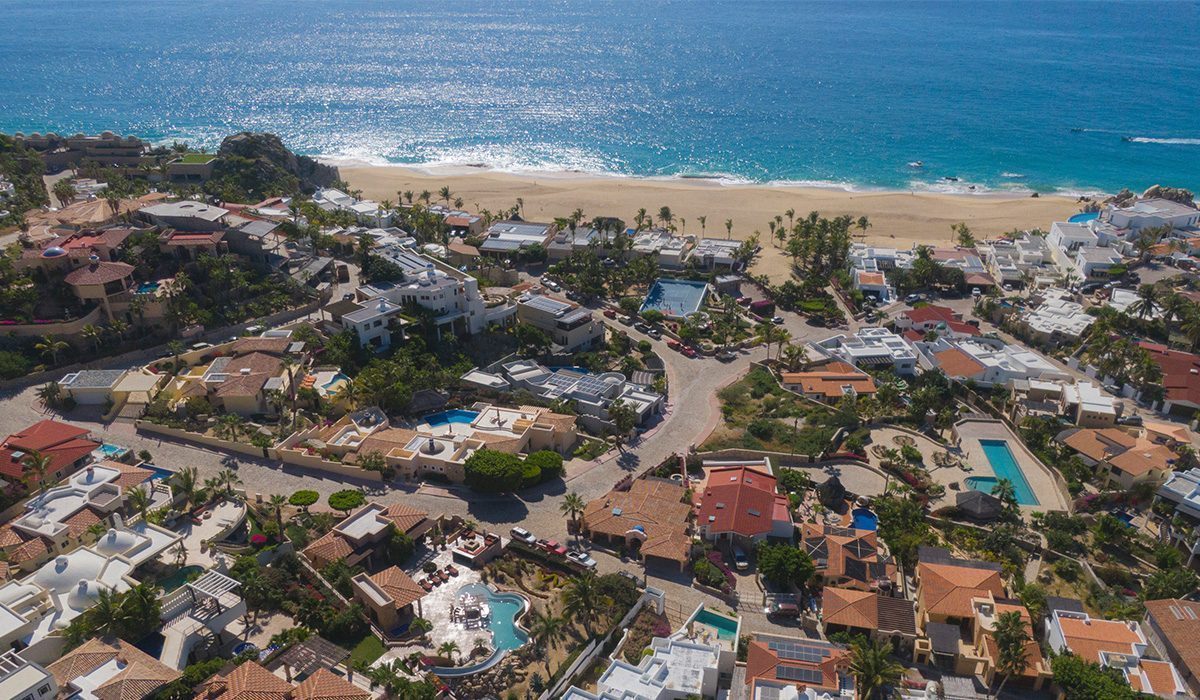
In Los Cabos, a well-located two-bedroom condo in a quality development like Cabo del Sol or Quivira starts in the $350,000 to $500,000 range. A comparable oceanfront or ocean-view unit in a resort community with full amenities — pool, gym, concierge, beach club — runs $500,000 to $800,000. You have to get into the branded-residence or beachfront villa tier before you're consistently above $1 million.
That means the entry point in Cabo is roughly 2.5 to 3 times lower than TCI for comparable quality of construction, amenities, and ocean proximity. The zero-tax advantage of TCI has to overcome a $500,000 to $900,000 price gap at the entry level before it starts winning on pure economics.
Closing Costs: Where TCI's Tax-Free Image Cracks
Turks and Caicos charges stamp duty — a transfer tax — on nearly all property purchases. The rates on Providenciales, the main residential island:
| Property Value (TCI) | Stamp Duty Rate |
|---|---|
| Under $25,000 | 0% |
| $25,000 – $250,000 | 6.5% |
| $250,000 – $500,000 | 8% |
| $500,000+ | 10% |
On a $1 million condo purchase in TCI, you're paying $100,000 in stamp duty alone, plus attorney fees of $7,500 to $10,000. Total closing costs: $107,500 to $110,000, or roughly 10.5 to 11 percent of the purchase price.
In Los Cabos, the same $1 million property incurs approximately $40,000 to $60,000 in total closing costs — notario fees, acquisition tax (ISABI), appraisal, fideicomiso setup, and miscellaneous. That's 4 to 6 percent. Our complete closing costs guide breaks these down line by line.
So TCI's "no property tax" advantage gets partially offset right at the closing table by a stamp duty that's roughly double Cabo's total closing cost percentage.
Ownership Structure: Freehold vs. Fideicomiso
TCI wins on simplicity here: foreigners can own property freehold, with no trust structure required and no annual renewal fees. You buy it, it's yours, deed in your name, done.
In Mexico, coastal property purchased by foreigners goes through a fideicomiso — a bank trust that grants you full beneficial ownership rights (use, sell, rent, bequeath) but requires an annual maintenance fee of roughly $500 to $800 and renewal every 50 years. It works, it's well-established, and it's not the dealbreaker some people make it out to be — but it's objectively more complex than TCI's freehold system.
The counterweight: fideicomiso administration is a known, solved cost. TCI's freehold simplicity comes bundled with dramatically higher property prices and closing costs that dwarf the fideicomiso's ongoing fees by orders of magnitude.
The Full Tax Picture
TCI's headline claim is real: zero property tax, zero income tax, zero capital gains tax. For investors holding long-term and selling at a large gain, that's meaningful.
Mexico's tax picture is more nuanced:
- Property tax (predial): 0.1 to 0.3 percent of assessed value annually. On a $500,000 property, that's roughly $500 to $1,500 per year. This is negligible by any US comparison. See our property tax guide.
- Capital gains tax (ISR): 25 to 35 percent on the gain, depending on holding period and deductions. This is the real cost of Mexican ownership compared to TCI, and it matters most if you're buying to flip. Long-term holders who take advantage of US-Mexico tax treaty provisions can offset much of this against their US tax obligation.
- Rental income tax: Mexico taxes rental income, though effective rates for foreign owners are typically 25 percent on gross or actual expenses can be deducted for a lower net rate. TCI charges nothing.
Where it nets out: if you're buying and holding for 10-plus years as a vacation home with moderate rental income, the annual tax drag in Cabo is minimal — maybe $1,500 to $3,000 per year on a $500,000 property, depending on rental activity. You'd need to hold for decades before that accumulated tax difference overcomes the initial $500,000-plus price gap.
Want the Full Tax Breakdown for Your Situation?
The comparison depends heavily on your hold period, rental strategy, and US tax situation. Book a call and I'll run the numbers.
Book a CallRental Income: Cabo's Accessibility Advantage
Both markets are strong vacation rental destinations, but Cabo has structural advantages that show up in the numbers.
Los Cabos vacation rental yields run 6 to 10 percent gross, driven by year-round demand from 30-plus direct flight routes connecting SJD to cities across the US and Canada. Peak season runs November through April, but summer months still see solid occupancy from families and the growing digital-nomad segment. Our rental income by month breakdown shows actual seasonal performance.
TCI rental yields are typically 4 to 7 percent gross. The peak season is narrower (December through April), operating costs are higher because nearly everything on the island is imported, and the flight access is more limited — primarily Miami, JFK, Charlotte, and Atlanta, with some seasonal additions.
Critically, Cabo's lower purchase price amplifies the yield advantage. A $450,000 Cabo condo generating $36,000 in annual rental income delivers an 8 percent gross yield. A $1.4 million TCI condo would need to generate $98,000 in annual rent to match that yield — which requires virtually year-round occupancy at premium rates.
Lifestyle and Infrastructure
This is where the comparison diverges most dramatically, and it's the factor that matters most for anyone considering part-time or full-time living rather than pure investment.
Los Cabos has a metro population of 350,000-plus people, two hospitals, international schools, Costco, Home Depot, fiber internet in many communities, a deep restaurant scene, championship golf courses at Diamante, Querencia, and Palmilla, and an established expat community with years of institutional knowledge about how to actually live here. I've covered the full picture in my expat guide.
Turks and Caicos has a total population of roughly 46,000 across 40 islands and cays. Healthcare is limited — serious medical issues require medevac to Miami. Groceries and goods cost 30 to 50 percent more than mainland US prices because nearly everything arrives by ship. The restaurant and entertainment scene, while improving, is proportional to a small-island population. Internet service exists but is not at the level most remote workers need for reliable video calls.
TCI is a superb vacation destination. It's not built for full-time living, and it's not trying to be. Cabo is.
When TCI Actually Wins
I'm not here to say TCI is a bad investment — it's not. It wins in specific scenarios:
- Ultra-high-net-worth buyers who are buying at $3 million-plus and care more about tax structure than entry price.
- Pure investment plays with very long hold periods where the zero capital gains tax compounds into real savings.
- British and European buyers who value TCI's British legal system and English as the default language.
- Residency through investment: TCI's Permanent Resident Certificate through property investment (typically $300,000-plus) is a pathway some buyers value for tax planning purposes.
For the majority of my clients — Americans and Canadians buying in the $300,000 to $1.5 million range, looking for a vacation home they can also rent and possibly retire to — Cabo delivers more value per dollar, more accessibility, and more infrastructure for actually using the property.
The Bottom Line
TCI's zero-tax headline is real, but it's attached to an entry price that's 2.5 to 3 times higher than Cabo's. By the time you factor in the 10 percent stamp duty at closing, higher operating costs, limited flight access, and lower rental yields on a per-dollar basis, the tax savings take years — often decades — to offset the initial price premium.
Cabo gives you more house for the money, better rental yield math, easier access from more US and Canadian cities, and infrastructure that supports actual living — not just vacationing. The tax costs are real but modest, and the overall economics favor Cabo for most buyers I work with.
Both are beautiful places to own property. Only one of them works as a realistic second-home destination for a buyer who doesn't want to spend $1.5 million at the entry level.
Sources: Visit TCI Real Estate Prices, Grace Bay Realty 2026 Market Data, TCI Stamp Duty Rates.
Ready to Compare Specific Properties?
I'll run the full cost-of-ownership comparison for any Cabo listing against what you'd pay in TCI or any other Caribbean market.
Get In TouchFrequently Asked Questions
Is Turks and Caicos cheaper than Los Cabos for real estate?+
No. Turks and Caicos is significantly more expensive. The median two-bedroom home price in TCI is $995,000 as of mid-2025, and the average condo sale price is approximately $1.4 million. In Los Cabos, the median condo price sits around $450,000-$550,000, and you can find quality two-bedroom units in developed communities starting under $400,000. TCI's entry point is roughly 2.5 to 3 times higher than Cabo's for comparable quality.
What are the closing costs in Turks and Caicos compared to Cabo?+
Turks and Caicos closing costs run 8.5 to 10 percent of the purchase price, driven almost entirely by the stamp duty transfer tax of 6.5 to 10 percent depending on property value and island. Attorney fees add another 0.75 to 1 percent. In Los Cabos, closing costs are typically 4 to 6 percent, including notario fees, acquisition tax, appraisal, and fideicomiso setup. On a $1 million property, you'd pay roughly $85,000-$100,000 in TCI versus $40,000-$60,000 in Cabo.
Can foreigners buy property freely in Turks and Caicos?+
Yes. TCI allows full freehold ownership by foreigners with no restrictions — no trust structure required, no special permit needed. This is simpler than Mexico's fideicomiso requirement for coastal property. However, the simplicity comes at a higher cost: TCI's stamp duty is a flat transfer tax that runs up to 10 percent, and the overall price per square foot ($481 to $995 across all islands) is substantially higher than Cabo's.
Which has better rental yields — Cabo or Turks and Caicos?+
Los Cabos generally delivers higher rental yields. Cabo vacation rental ROI runs 6 to 10 percent gross depending on community and management, with strong year-round demand driven by 30-plus direct US and Canadian flight routes. TCI rental yields are typically 4 to 7 percent gross, with a shorter peak season and higher operating costs due to the island's import-dependent economy. Cabo's lower entry price amplifies the yield advantage.
Does Turks and Caicos have property taxes?+
No. TCI has zero property tax, zero income tax, and zero capital gains tax — it's one of the world's most tax-favorable jurisdictions for property ownership. Mexico does charge property tax (predial), though rates are very low at 0.1 to 0.3 percent of assessed value annually, and Mexico charges capital gains tax on property sales. The tax-free advantage of TCI sounds decisive until you factor in the 10 percent stamp duty at purchase and the dramatically higher property prices.
How do flight times compare between Cabo and Turks and Caicos from major US cities?+
Both destinations are accessible from the US in 2 to 5 hours, but Cabo has a significant advantage in flight frequency and route diversity. SJD airport has direct service from 30-plus North American cities, with multiple daily flights from LA, Dallas, Houston, Phoenix, Denver, San Francisco, and many others. TCI's Providenciales airport has direct flights from a more limited set of US cities — primarily Miami, New York (JFK), Charlotte, Atlanta, and a few seasonal routes. Cabo is simply easier to reach from more places.
Which destination has better infrastructure for full-time living?+
Los Cabos has significantly better infrastructure for full-time or part-time living. It has hospitals, international schools, Costco, Home Depot, fiber internet in many developments, a large and growing expat community with established social networks, and the full range of daily-life services you'd expect in a metro area of 350,000-plus people. Turks and Caicos has a population of about 46,000, limited healthcare facilities, and an import-dependent economy where goods cost 30 to 50 percent more than in the US. TCI is superb for vacations and part-time use; Cabo works for full-time living.

Aaron Cuha
Real Estate Advisor & Los Cabos Market Expert
Real estate advisor and founder of Living In Cabo. 15+ years helping families navigate complex real estate decisions. Strategic partner with Ronival — Baja's largest brokerage.