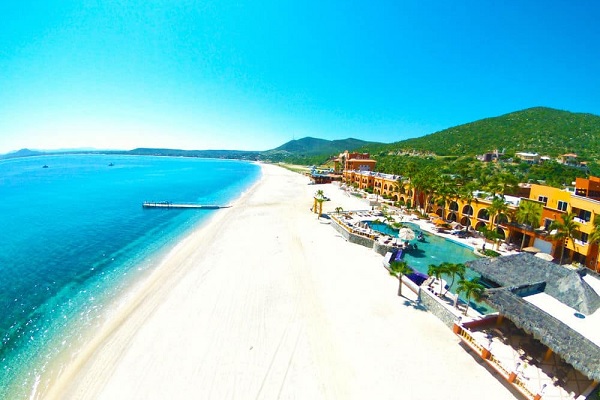
The Tourist Corridor is the 20-mile stretch of Highway 1 between Cabo San Lucas and San Jose del Cabo, and it contains the most valuable real estate per linear mile in all of Mexico. Properties here command a 20 to 40 percent premium over comparable properties in either town — and that gap keeps widening.
Key Takeaways
- The Corridor stretches 20 miles (33 km) along the Transpeninsular Highway between Cabo San Lucas and San Jose del Cabo
- Development began with Palmilla in 1956 — the first resort on the Baja peninsula
- Corridor properties command a 20 to 40% premium over comparable properties in either town
- The corridor hosts Los Cabos' highest concentration of luxury brands: One&Only, Montage, Waldorf Astoria, Park Hyatt
- Entry points start around $400,000 for condos; oceanfront villas reach $15 million or more
Explore the Tourist Corridor With Expert Guidance
From Palmilla to Cabo del Sol, we know every community along this 20-mile stretch. Let us match you with the right one.
Contact Us TodayFrom Empty Desert to Mexico's Most Valuable Coastline
I have driven the Tourist Corridor hundreds of times. In 2019, the stretch between Cabo Real and Chileno Bay was mostly scrub and construction fencing. Today it is home to Montage residences that sell for $5 to $15 million. That transformation — empty desert to nine-figure community — happened in less than five years.
But the Corridor's story starts much earlier. Here are the milestones that turned this stretch of Highway 1 from a dusty two-lane road into the most sought-after address in Mexico:
The Pioneers: 1956 to 1977
1956 — Palmilla is founded. Don Abelardo Rodriguez Jr., son of a former president of Mexico, built the Hotel Palmilla as a private fishing retreat for Hollywood royalty and international elite. It was the first resort on the Baja peninsula and remained the only significant development along the Corridor for nearly two decades. Today, Palmilla is still one of the most prestigious addresses in Los Cabos, anchored by the One&Only Palmilla resort.
1973 — The Transpeninsular Highway is completed. Before Highway 1 connected Cabo San Lucas to the rest of the peninsula (and eventually to Tijuana, over 1,000 miles north), the only reliable access was by boat or small aircraft. The highway opened the entire Corridor to potential development — though it would take years before that potential was realized.
1977 — Hotel Twin Dolphin opens. Built on a dramatic clifftop site at what is now the Twin Dolphin community (around KM 15), this intimate resort became one of the most celebrated small hotels in the Americas. The hotel closed in 2006 to make way for a Montage-branded development. Its legacy defined the Corridor's identity as a place of understated luxury and dramatic natural settings.
1977 — Los Cabos International Airport opens. The airport (SJD) at the San Jose del Cabo end of the Corridor changed everything. Suddenly, the Corridor was accessible by direct flights from Los Angeles, Phoenix, Dallas, and other major US cities. This is the moment development pressure along the Highway 1 coast began in earnest.
The Resort Corridor Takes Shape: 1980s to 2000s
1994 — Cabo del Sol launches with a Jack Nicklaus Signature course. Cabo del Sol (around KM 10-12) brought championship golf to the Corridor and established the model that most subsequent communities would follow: a branded golf course as the anchor, surrounded by residential lots, villas, and condominiums. The Desert Course (Nicklaus) was followed by the Ocean Course (Tom Weiskopf), and today Cabo del Sol is one of the largest and most diverse communities in the Corridor.
2002 — Esperanza, an Auberge Resort, opens. This was a pivotal moment for the Corridor's luxury positioning. Esperanza brought the Auberge brand's focus on culinary excellence and intimate scale to a dramatic clifftop site near Cabo San Lucas. It signaled to the international hospitality industry that the Corridor could support ultra-luxury pricing.
2004 — Hotel Palmilla rebrands as One&Only Palmilla. The acquisition and repositioning of the original Palmilla resort by the One&Only brand (now part of Kerzner International) was a statement: the Corridor was no longer an emerging destination. It was competing directly with the world's finest coastal resorts. The One&Only Palmilla remains one of the highest-rated resorts in North America.
The Modern Era: 2010s to Present
2014 — Hurricane Odile tests the Corridor. The Category 3 storm caused significant damage to older properties and commercial infrastructure, but the post-storm rebuild catalyzed a massive upgrade in building standards, infrastructure, and development quality across the Corridor.
2018 — Montage Los Cabos opens. Built on the former Hotel Twin Dolphin site, Montage Los Cabos brought one of North America's most prestigious hospitality brands to the Corridor. Montage residences have set price records for the Corridor, with oceanfront villas trading at $10 million or more.
2026 — Park Hyatt Los Cabos opens. The latest major luxury brand to arrive in the Corridor, adding another tier of branded residential product. The Park Hyatt is part of a larger wave of institutional-grade hospitality investment that validates the Corridor's position as a global luxury destination.
Ready to Tour the Tourist Corridor?
We will build a personalized tour itinerary based on your budget, lifestyle, and investment goals — covering every community that fits.
Book a CallKM Markers: What Is Where Along the Corridor
Locals and agents reference the Corridor by kilometer markers on Highway 1, counting from San Jose del Cabo toward Cabo San Lucas. Here is a guide to the major landmarks:
| KM Marker | Community / Landmark | Highlights |
|---|---|---|
| KM 27-28 | Puerto Los Cabos area | Marina, Greg Norman & Nicklaus courses |
| KM 25 | Palmilla | One&Only resort, 27-hole Nicklaus course |
| KM 22-23 | Querencia | Tom Fazio course, ultra-private hilltop community |
| KM 19-20 | Cabo Real | Robert Trent Jones II course, Hilton & Dreams resorts |
| KM 15-16 | Chileno Bay / Twin Dolphin | Montage, Waldorf Astoria, best snorkeling beach |
| KM 10-12 | Cabo del Sol / El Dorado | Nicklaus & Weiskopf courses, Solaz resort |
| KM 5-6 | Approaching Cabo San Lucas | Costco, commercial corridor, transition to town |
The highest concentration of luxury residential development sits between KM 10 and KM 25. This is the heart of the Corridor — the stretch where every major international hospitality brand has either built or is planning to build.
Why Corridor Properties Command a Premium
The 20 to 40 percent premium that Corridor properties carry over comparable properties in Cabo San Lucas or San Jose del Cabo is not arbitrary. It is driven by several reinforcing factors:
- Location between both towns: Corridor residents have access to Cabo San Lucas nightlife and marina on one end and San Jose del Cabo's art district and historic center on the other — a 15 to 25 minute drive in either direction
- Direct beach access at premium coves: Chileno Bay and Santa Maria Bay are consistently ranked among Mexico's best beaches, and they are only accessible through Corridor communities or by boat
- Golf concentration: More championship courses per mile than any comparable stretch of coastline in the Americas
- Brand density: One&Only, Montage, Waldorf Astoria, Park Hyatt, Four Seasons (planned) — this concentration of luxury hotel brands creates a halo effect on residential values
- Privacy and scale: Corridor communities offer larger lots, lower density, and more privacy than the town-center alternatives
- Finite supply: The Corridor is 20 miles long and cannot expand. Every new development reduces the remaining supply of undeveloped land, which supports long-term price appreciation
Infrastructure: The Story Behind the Story
The Corridor's premium is not just about beautiful coastline. The Mexican federal and state governments have invested billions in infrastructure that specifically supports property values:
- Highway 1 widening: The Transpeninsular Highway through the Corridor has been widened to four lanes (divided) with modern interchanges, cutting drive times between towns and improving safety
- Fiber optic backbone: High-speed internet infrastructure now serves the entire Corridor, enabling the remote-work lifestyle that drives demand from US and Canadian buyers
- Water infrastructure: Municipal and private desalination capacity serves the Corridor's developments, with ongoing expansion to support new projects
- Power grid upgrades: Post-Hurricane Odile, the electrical grid through the Corridor has been substantially upgraded with underground lines in new developments and hardened above-ground infrastructure
These are not optional amenities. They are the backbone of a real estate market that has attracted institutional-grade investment from the world's most sophisticated hospitality brands. When Montage, Waldorf Astoria, and Park Hyatt commit to a market, they have done the infrastructure due diligence that individual buyers often skip.
Corridor Entry Points by Budget
The Corridor is not exclusively ultra-luxury. Here is how entry points break down:
- $300,000 to $500,000: Condos in communities like Cabo Real and select Cabo del Sol developments — 1 to 2 bedrooms, shared amenities, rental income potential
- $500,000 to $1 million: Larger condos and townhomes with ocean views, golf course access, and branded management programs
- $1 million to $3 million: Detached villas in established communities, some with direct ocean views and private pools
- $3 million to $8 million: Premium villas in top communities with ocean frontage, private infinity pools, and concierge services
- $8 million and above: Oceanfront estates and Montage/Waldorf Astoria branded residences at Chileno Bay and Twin Dolphin
What Is Still Undeveloped — And What Is Coming
One of the most important things to understand about the Corridor is that undeveloped land is running out. Several significant parcels between existing communities remain, and they will not stay empty forever. Development applications continue to be filed, and the quality of new entrants keeps rising.
The trend is clear: every year, the supply of undeveloped Corridor land shrinks, and the barrier to entry rises. Buyers who enter the Corridor today are buying into a finite-supply market with continuously increasing demand.
For detailed community profiles, explore our guides to Palmilla, Cabo del Sol, Chileno Bay, Twin Dolphin, Cabo Real, and El Dorado. Or visit our resource library for downloadable guides and investment analysis tools.
Find Your Place in the Corridor
Whether you are looking at a $400,000 condo or a $10 million oceanfront villa, we will help you find the right community along this 20-mile stretch.
Get StartedFrequently Asked Questions
What is the Tourist Corridor in Los Cabos?+
The Tourist Corridor is the approximately 20-mile (33-kilometer) stretch of the Transpeninsular Highway (Highway 1) between Cabo San Lucas and San Jose del Cabo. It is home to Los Cabos' most exclusive resort communities, championship golf courses, and luxury developments. Properties in the Corridor typically command a 20 to 40 percent premium over comparable properties in Cabo San Lucas or San Jose del Cabo.
Why are Tourist Corridor properties more expensive?+
Corridor properties command premiums of 20 to 40 percent because of their location between both towns, direct beach access at premium coves (Chileno Bay, Santa Maria Bay), proximity to championship golf courses, and the concentration of luxury hotel brands (One&Only, Montage, Waldorf Astoria, Park Hyatt). The Corridor also offers more privacy and larger lot sizes than the town centers.
What is the history of development in the Tourist Corridor?+
The Corridor's development began in 1956 with Palmilla, founded by the son of a former Mexican president. It remained relatively undeveloped until the Transpeninsular Highway was completed in 1973 and the Los Cabos International Airport opened in 1977. Major milestones include the Hotel Twin Dolphin opening in 1977, Cabo del Sol with its Nicklaus course in 1994, and the Montage in 2018. Today it hosts over a dozen master-planned resort communities.
What are the best beaches in the Tourist Corridor?+
The Corridor's top swimmable beaches are Chileno Bay (calm, protected cove ideal for snorkeling), Santa Maria Bay (crescent-shaped reef-protected beach), and Palmilla Beach (gentle surf, one of the safest swimming beaches on the Sea of Cortez side). Many Corridor beaches have strong currents and are best for surfing rather than swimming — always check local conditions.
How far is the Tourist Corridor from the airport?+
The Los Cabos International Airport (SJD) sits at the San Jose del Cabo end of the Corridor. Depending on where your property is located, drive times range from 10 minutes (communities near San Jose) to 35 to 45 minutes (communities near the Cabo San Lucas end). Average drive time to a mid-Corridor community is about 20 to 25 minutes.
What KM markers should I know in the Tourist Corridor?+
Key markers along Highway 1 from San Jose del Cabo toward Cabo San Lucas include: KM 27 area for Puerto Los Cabos, KM 25 for Palmilla, KM 19-20 for Cabo Real, KM 15-16 for Chileno Bay and Twin Dolphin, KM 10-12 for Cabo del Sol and the El Dorado area, and KM 5-6 approaching Cabo San Lucas. Development density is highest between KM 10 and KM 25.
Is the Tourist Corridor a good real estate investment?+
The Corridor has consistently been the strongest appreciating real estate market in Los Cabos. The finite supply of oceanfront land along a 20-mile stretch, the concentration of luxury brands, and the continuous infrastructure investment (Highway 1 widening, fiber optic, desalination) support long-term value. Entry points start around $400,000 for condos in communities like Cabo Real, with oceanfront villas reaching $15 million or more.
What new developments are planned for the Tourist Corridor?+
The Corridor continues to attract major luxury hotel and residential brands. Recent arrivals include the Park Hyatt Los Cabos (opened 2026) and residential communities by Aman and Four Seasons are in various stages of planning or construction. Several parcels between existing developments remain available for future projects, but the supply of undeveloped Corridor land is finite and shrinking.

Aaron Cuha
Real Estate Advisor & Los Cabos Market Expert
Real estate advisor and founder of Living In Cabo. 15+ years helping families navigate complex real estate decisions. Strategic partner with Ronival — Baja's largest brokerage.