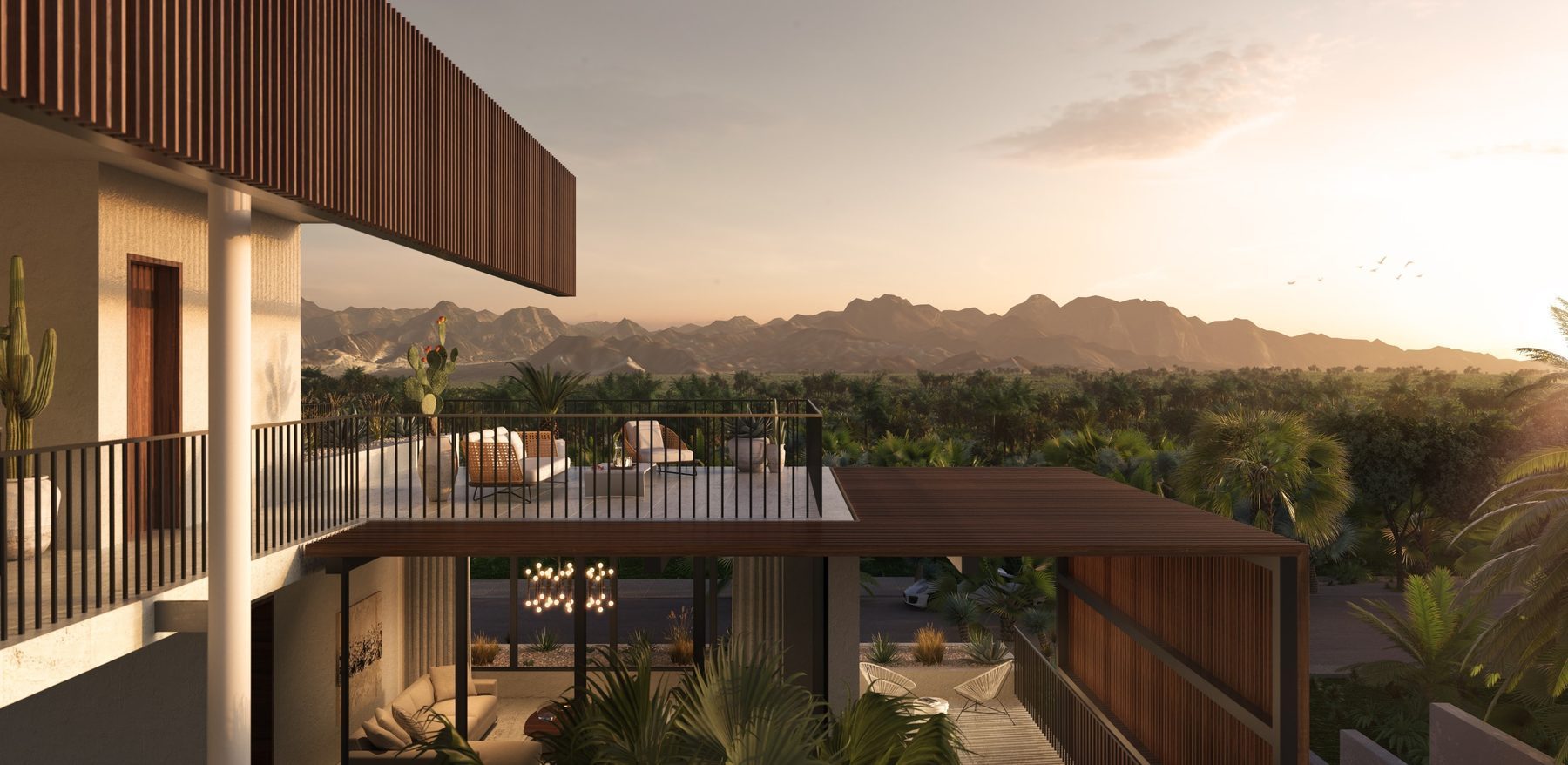
Every property in Los Cabos sits on land that carries a zoning classification called the uso de suelo — literally "use of the soil." This single document, issued by the municipal Dirección de Desarrollo Urbano, determines what can be built on that land, how tall it can go, how much of the lot it can cover, and what activities are permitted inside. It is the most important document most foreign buyers never read, and the reason I have watched people discover — after closing — that their ocean view is about to disappear behind a six-story hotel.
KEY TAKEAWAYS
- The uso de suelo (land use certificate) determines what can be built on any lot in Los Cabos — height, coverage, permitted activities — and is issued by the municipal Dirección de Desarrollo Urbano
- Four main zoning classifications: Habitacional (residential, 2-3 stories), Turístico (tourist/hotel, 6-12 stories), Mixto (mixed use, 4-8 stories), and Comercial (commercial)
- COS (Coeficiente de Ocupación del Suelo) controls lot coverage — typically 60-70% for residential, 40-60% for tourist zones — while CUS (Coeficiente de Utilización del Suelo) controls total buildable floor area
- Your view is only as safe as the zoning on the lot between you and the ocean — a Turístico classification on a neighboring parcel means a potential 6-12 story building
- The PDU (Plan de Desarrollo Urbano) for Los Cabos is the master document that governs all zoning — it gets updated roughly every 5-10 years, and reclassifications can dramatically change what is buildable
DUE DILIGENCE
Know What You Are Buying
We verify the uso de suelo on every property and every neighboring parcel before our buyers make an offer — because the zoning next door matters as much as the zoning on your lot.
Contact Us TodayWhat the Uso de Suelo Actually Is
The uso de suelo is a constancia (certificate) that states the permitted land use for a specific parcel. Think of it as Mexico's equivalent of a US zoning designation — R1, C2, etc. — but with more specific parameters built into the document itself.
You obtain one from the Dirección de Desarrollo Urbano (Urban Development Office) in either Los Cabos municipality — Cabo San Lucas falls under one municipal jurisdiction, and San Jose del Cabo under another, though both follow the same PDU framework. The certificate states:
- Land use classification — what category the property falls under
- Permitted activities — residential, commercial, hotel, mixed, or specific subcategories
- COS (Coeficiente de Ocupación del Suelo) — the maximum percentage of the lot that can be covered by buildings (lot coverage ratio)
- CUS (Coeficiente de Utilización del Suelo) — the maximum total floor area relative to the lot size (floor area ratio)
- Maximum height — usually stated in stories and/or meters
- Setback requirements — minimum distance from lot boundaries to buildings
- Density restrictions — maximum number of dwelling units per hectare
This is not optional reading. This is what determines whether your three-story villa can legally exist, whether the vacant lot next door can become a hotel, and whether you can run short-term rentals from your condo. Our construction permits guide covers the permits you will need after the zoning is confirmed.
The Four Main Zoning Classifications
Habitacional (Residential)
This is the standard residential zoning. Single-family homes, duplexes, and low-rise residential condominiums. The parameters in Los Cabos typically look like:
- Maximum height: 2-3 stories (8-12 meters)
- COS: 60-70% (you can cover 60-70% of the lot with structure)
- CUS: 1.2-1.8 (total buildable floor area is 1.2-1.8x the lot size)
- Front setback: 3-5 meters
- Side setbacks: 1.5-3 meters
- Permitted: Single-family homes, apartments, small condos
- Restricted: No hotels, no commercial retail, no short-term rentals in some subcategories
Most gated residential communities — Pedregal, Querencia, Palmilla's residential sections — sit on Habitacional land. The height cap is what protects your sight lines: your neighbor cannot build higher than 2-3 stories no matter how much money they have.
Turístico (Tourist / Hotel)
This is where things get expensive — and tall. Turístico zoning allows hotel and resort development with significantly more generous parameters:
- Maximum height: 6-12 stories (24-48 meters), sometimes higher with special permits
- COS: 40-60% (lower lot coverage, but buildings go up instead of out)
- CUS: 2.0-4.0+
- Permitted: Hotels, resorts, condohotels, tourist condominiums, restaurants, retail within the complex
- Key detail: Many of the branded residences in the Corridor — Park Hyatt, Montage, Nobu, Four Seasons — sit on Turístico land. This is what allows them to build the towers and resort infrastructure that residential zoning would prohibit.
If you buy a condo in a Turístico zone, you benefit from the resort amenities that zoning enables. But if you buy a residential home with a Turístico parcel between you and the ocean, understand that a 6-12 story building can legally appear there. I have seen it happen on the Corridor more than once.
Mixto (Mixed Use)
Mixed-use zoning permits a combination of residential, commercial, and sometimes light tourist activity on the same parcel:
- Maximum height: 4-8 stories
- COS: 50-70%
- CUS: 1.5-3.0
- Permitted: Ground-floor retail with residential above, offices, restaurants, small hotels
Downtown Cabo San Lucas and parts of downtown San Jose del Cabo carry Mixto zoning. This is what allows the ground-floor restaurants and shops with apartments above that give these neighborhoods their walkable character. Fonatur's grid includes Mixto zones near its commercial strips.
Comercial (Commercial)
Pure commercial zoning for retail, office, and service businesses. Less relevant for residential buyers, but critical to understand if you are buying a property near a commercial corridor — the noise, traffic, and building scale allowed under Comercial zoning may surprise you.
Why the Zoning on Your Neighbor's Lot Matters More Than Yours
This is the lesson that costs people money. You buy a beautiful two-story villa with an unobstructed ocean view. You verified your lot's zoning. What you did not verify is the zoning on the vacant lot between your property and the water.
If that vacant lot carries Turístico zoning, a developer can legally build a 6-12 story hotel or condohotel that blocks your view entirely. Your property value drops 20-40% overnight, and there is no legal recourse because the developer is building within their zoning rights.
I tell every buyer the same thing: verify the uso de suelo on every parcel between your property and the view you are paying for. If there is a vacant lot, an undeveloped parcel, or a single-story structure on Turístico or Mixto land between you and the ocean, assume a taller building will eventually appear there. Price your offer accordingly, or walk away.
The Corridor between Cabo San Lucas and San Jose del Cabo is the highest-risk area for this. Large tracts of Turístico land line the highway, and the development pipeline for 2026-2031 includes multiple high-rise projects. Our Corridor development pipeline guide shows what is coming.
PROTECT YOUR VIEW
Zoning Due Diligence Before You Offer
We pull the uso de suelo on your target property AND every neighboring parcel, so you know exactly what can be built around you before you commit a dollar.
Book a CallCOS and CUS: The Numbers That Control Your Build
These two coefficients trip up every foreign buyer who wants to build a custom home in Los Cabos.
COS (Coeficiente de Ocupación del Suelo) is the lot coverage ratio — the maximum percentage of the lot that can be covered by building footprint. A COS of 0.60 on a 500 m² lot means your building footprint cannot exceed 300 m².
CUS (Coeficiente de Utilización del Suelo) is the floor area ratio — the total buildable floor area divided by the lot size. A CUS of 1.5 on a 500 m² lot means you can build up to 750 m² of total floor space. With a COS of 0.60, you would need at least two stories to use the full CUS allowance (300 m² per floor × 2.5 floors = 750 m²).
In practice, this means:
- A large lot with a low COS but high CUS encourages taller, narrower buildings with more open space around them
- A small lot with a high COS but low CUS limits you to a low, wide building that covers most of the lot
- The setback requirements further constrain the buildable envelope — on a 15-meter-wide lot with 3-meter side setbacks, you only have 9 meters of width to work with
Your architect and your notario should both review the uso de suelo before you finalize any construction plans. A design that exceeds COS or CUS will not receive a building permit (licencia de construcción), and any construction done without a permit is subject to demolition orders.
How to Verify Zoning Before You Buy
The process is straightforward but requires persistence:
- Request the uso de suelo from the seller. Any serious seller should have this document or be willing to obtain it. If they resist, that is a red flag.
- Verify independently. Go to the Dirección de Desarrollo Urbano yourself (or have your agent go) with the property's catastral number and request a constancia de uso de suelo. The office is in the municipal building in either San Jose del Cabo or Cabo San Lucas depending on which jurisdiction the property falls under.
- Check the PDU map. The Plan de Desarrollo Urbano includes zoning maps for the entire Los Cabos municipality. These should be available at the Desarrollo Urbano office. They show the classification of every parcel — including the lots around your target property.
- Check neighboring parcels. Request the uso de suelo for every parcel between your property and the primary view corridor. Yes, this is extra work. Yes, it is worth it.
- Ask about pending reclassifications. Developers routinely petition for zoning changes (cambio de uso de suelo) to build projects that the current classification would not permit. Ask at the Desarrollo Urbano office whether any reclassification petitions are pending for parcels near your property.
When Zoning Changes — And What You Can Do About It
The PDU for Los Cabos gets updated roughly every 5-10 years. When it does, parcels can be reclassified. A Habitacional lot can become Mixto. An agricultural parcel can become Turístico. These reclassifications are where fortunes are made in Los Cabos real estate — a developer who buys agricultural land at $20/m² and gets it reclassified to Turístico suddenly holds land worth $200-$500/m².
Individual cambio de uso de suelo (zoning change) petitions can also be filed between PDU updates. The process involves environmental impact studies, municipal hearings, and sometimes community input. But the reality is that well-connected developers with large projects tend to get their reclassifications approved.
What can you do?
- Buy in established gated communities. Communities like Pedregal, Querencia, and Palmilla have internal covenants and master plans that constrain development beyond what municipal zoning requires. A gated community's internal regulations (reglamento interno) create an additional layer of protection.
- Buy where the zoning around you is already built out. If every parcel within your view corridor is already developed with structures at or near maximum height, there is nothing taller coming.
- Participate in PDU public comment periods. When the PDU update process begins, there are public comment periods where property owners can raise concerns about proposed reclassifications. Expat participation is low, which means organized groups of homeowners in affected areas can have outsized influence.
Zoning and Short-Term Rentals
One of the most common questions I get: "Can I legally Airbnb my Cabo condo?" The answer often depends on the uso de suelo.
Properties on Turístico land generally have clear rights to operate as short-term rentals — that is the intended use. Properties on Mixto land may permit short-term rental depending on the specific subcategory. Properties on Habitacional land are where it gets murky: some subcategories permit vacation rental, others do not, and enforcement varies by community and municipality.
Even if municipal zoning permits STR, the community's internal regulations (reglamento de condominio) can prohibit or restrict it. A condo in a community zoned Turístico but with HOA rules limiting rentals to 30-day minimums effectively cannot do Airbnb regardless of what the uso de suelo says.
Verify both: the municipal zoning AND the community's internal regulations. Our Airbnb regulations guide covers the current state of STR rules across Los Cabos.
The Bottom Line
The uso de suelo is not an obscure bureaucratic document. It is the single most important factor in determining what your property is worth, what you can do with it, and what can happen around it. A $2 million ocean-view villa on Habitacional land surrounded by Habitacional parcels is a safe investment. The same villa with a Turístico parcel between it and the ocean is a bet — and not one most buyers knowingly make.
Read the uso de suelo. Read the neighboring parcels' uso de suelo. Read the community's internal regulations. Do it before you fall in love with the view from the terrace, because that view is only as permanent as the zoning that protects it.
BUY WITH CONFIDENCE
Complete Zoning Due Diligence
We verify zoning, neighboring parcels, community regulations, and the development pipeline before you commit. Because the worst surprise in real estate is the one you did not see coming.
Get StartedFrequently Asked Questions
What is a uso de suelo in Mexico?+
The uso de suelo (literally 'use of the soil') is a zoning certificate issued by the municipal Dirección de Desarrollo Urbano that defines the permitted land use for a specific parcel. It specifies the zoning classification (residential, tourist, mixed, commercial), maximum building height, lot coverage ratio (COS), total buildable floor area (CUS), setback requirements, and permitted activities. Every property in Los Cabos has a uso de suelo classification that determines what can and cannot be built on the land.
How do I check the zoning on a Cabo property before buying?+
Request the uso de suelo certificate from the seller, then verify independently at the Dirección de Desarrollo Urbano with the property's catastral number. Also review the PDU (Plan de Desarrollo Urbano) zoning maps to check the classification of neighboring parcels — especially any lot between your property and the ocean or primary view. Ask whether any reclassification petitions (cambio de uso de suelo) are pending for nearby parcels. This process takes 1-2 weeks and costs approximately $100-$300 in fees.
What are the height restrictions for residential property in Los Cabos?+
Habitacional (residential) zoning in Los Cabos typically limits buildings to 2-3 stories (8-12 meters). Turístico (tourist/hotel) zoning allows 6-12 stories (24-48 meters), sometimes higher with special permits. Mixto (mixed use) zones allow 4-8 stories. These limits are set in the uso de suelo certificate and enforced through the building permit (licencia de construcción) process. Construction exceeding permitted height is subject to demolition orders.
What do COS and CUS mean in Mexico real estate?+
COS (Coeficiente de Ocupación del Suelo) is the lot coverage ratio — the maximum percentage of the lot that building footprint can cover. A COS of 0.60 on a 500 m² lot means maximum 300 m² of building footprint. CUS (Coeficiente de Utilización del Suelo) is the floor area ratio — total buildable floor area divided by lot size. A CUS of 1.5 on a 500 m² lot means up to 750 m² of total floor space across all stories. Both values are specified in the uso de suelo certificate.
Can my neighbor build a tall building that blocks my ocean view in Cabo?+
Yes, if the neighboring parcel has Turístico or Mixto zoning that permits taller buildings. A Turístico classification allows 6-12 story construction. This is why verifying the zoning on ALL parcels between your property and the ocean is essential before buying. Within gated communities, internal covenants and master plans provide additional protection beyond municipal zoning. In unincorporated areas, the uso de suelo is your only protection.
Can zoning change in Los Cabos?+
Yes. The PDU (Plan de Desarrollo Urbano) is updated every 5-10 years, and parcels can be reclassified during updates. Developers can also petition for individual cambio de uso de suelo (zoning change) between updates, which requires environmental impact studies and municipal hearings. Well-connected developers with major projects tend to get reclassifications approved. Buying in built-out areas or gated communities with internal covenants provides the most protection against unwanted zoning changes.
Does zoning affect whether I can Airbnb my Cabo condo?+
Yes. Properties on Turístico land generally have clear rights to short-term rentals. Habitacional zoning may restrict or prohibit vacation rental depending on the subcategory. Even if municipal zoning permits STR, the community's internal regulations (reglamento de condominio) can impose additional restrictions such as 30-day minimum stays. Verify both the municipal uso de suelo classification and the community's own rules before assuming you can operate short-term rentals.
What is the PDU for Los Cabos?+
The PDU (Plan de Desarrollo Urbano) is the master urban development plan for the Los Cabos municipality. It establishes zoning classifications for every parcel, infrastructure plans, environmental protection zones, growth corridors, and density limits. The PDU is updated roughly every 5-10 years by the municipal government with public comment periods. It is the governing document that the Dirección de Desarrollo Urbano references when issuing uso de suelo certificates and building permits. Copies of the zoning maps should be available at the Desarrollo Urbano office.

Aaron Cuha
Real Estate Advisor & Los Cabos Market Expert
Real estate advisor and founder of Living In Cabo. 15+ years helping families navigate complex real estate decisions. Strategic partner with Ronival — Baja's largest brokerage.