Austin and Los Cabos pull from the same buyer pool — outdoor-obsessed, food-motivated professionals who want a property that works financially, not just emotionally. I have closed deals in both markets, and the comparison is more nuanced than most real estate sites make it.
Here is the honest, data-driven breakdown of what your money buys in each market, what you keep after taxes and fees, and which lifestyle actually fits the way you want to live.
Key Takeaways
- Austin median home price ~$575K vs Los Cabos median ~$485K across all property types
- Austin property taxes (1.6-2.1%) cost 10-20x more annually than Cabo's predial (~0.1%)
- Cabo vacation rental yields of 6-10% outperform Austin's 4-6%, though Cabo income is more seasonal
- Direct AUS→SJD flights run 3 hours 10 minutes — shorter than driving to the Texas coast
- Neither market has state income tax, but Cabo rental income triggers Mexican ISR obligations
Exploring Both Markets?
We help buyers compare Cabo properties against their current US market — dollar for dollar, line by line. No spin, just numbers.
Start the ComparisonPrice Per Square Foot: Where Your Dollar Goes Further
Austin's median home price has stabilized around $565,000 to $580,000 as of mid-2026, according to the Austin Board of Realtors. That gets you a 1,800 to 2,200 square foot single-family home in the suburbs — Round Rock, Cedar Park, Kyle — or a 900 to 1,200 square foot condo in the urban core.
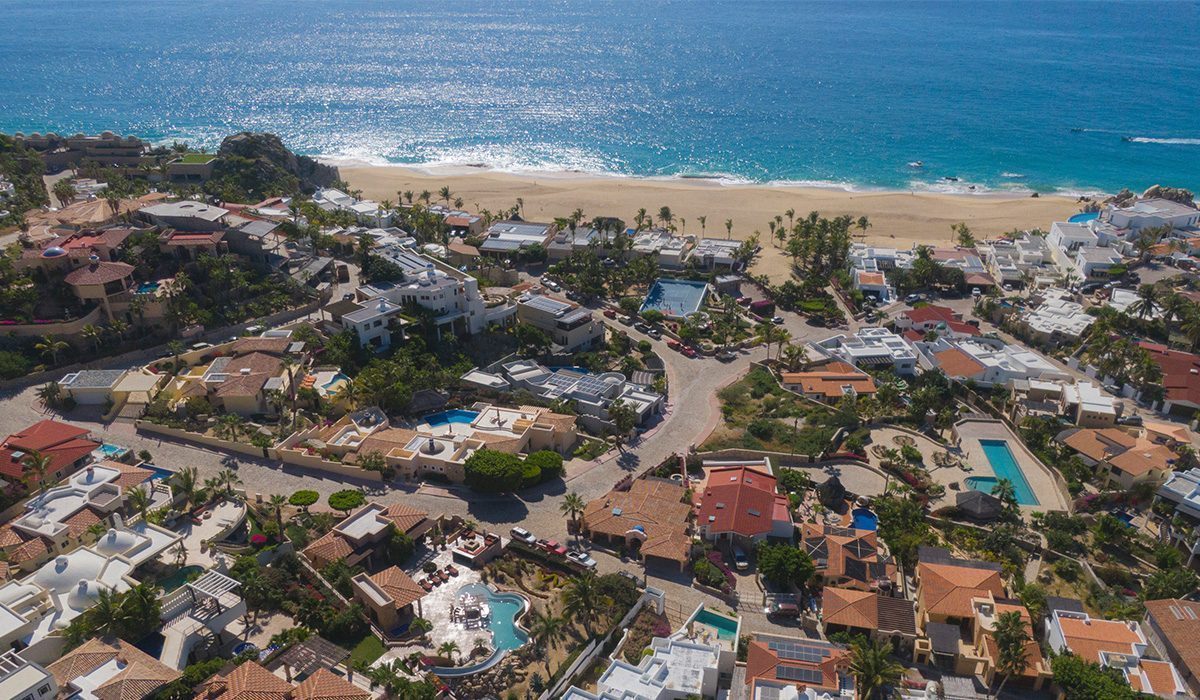
In Los Cabos, the median of approximately $485,000 buys dramatically different things depending on where you look. In San Jose del Cabo, that price point gets you a 1,400 to 1,800 square foot two-bedroom condo in a quality community with pool, gym, and ocean views. In Cabo San Lucas, you are looking at a similar or slightly larger unit in a marina-adjacent or beachfront-accessible development.
The Corridor skews the median up — properties along the Chileno Bay to Palmilla stretch routinely trade above $1 million. Strip those luxury transactions out and the working median for a typical international buyer's first purchase is closer to $380,000 to $450,000.
Price per square foot tells the real story:
| Metric | Austin | Los Cabos |
|---|---|---|
| Median price per sq ft (condo) | $380–$520 | $300–$600 |
| Median price per sq ft (SFH/villa) | $250–$350 | $350–$700 |
| Annual property tax | 1.6–2.1% | ~0.1% |
| State income tax | 0% | N/A (Mexican ISR applies) |
| HOA (resort/managed community) | $250–$600/mo | $200–$800/mo |
| Closing costs (buyer side) | 2–3% | 4–6% |
The takeaway: Austin condos are competitively priced per square foot, but the total cost of ownership diverges fast once property taxes enter the picture. On a $500K property, Austin's annual property tax bill runs $8,000 to $10,500. The same property in Cabo costs $300 to $800 in predial (property tax) plus $500 to $800 for the fideicomiso trust fee. Even adding a $400/month HOA, your annual holding cost in Cabo is roughly half what you would pay in Austin. See our annual ownership cost breakdown for the full picture.
Rental Income: Seasonal Beach vs Year-Round City
This is where the comparison gets interesting. Austin is a year-round rental market — SXSW, ACL, Formula 1, UT football, corporate relocations. Demand is relatively steady, and long-term rentals in the Austin market are well-supported by a growing tech workforce.
Los Cabos is a seasonal vacation rental market. November through April generates 65 to 70 percent of annual rental revenue. Summer months (June through October) are slower, with September being the weakest month. But the gross yields compensate: a well-managed Cabo vacation rental generates 6 to 10 percent gross yield, compared to Austin's 4 to 6 percent on a comparable property value. See our rental income by month data for seasonal patterns.
Austin short-term rental regulations have tightened considerably. The city has restricted non-owner-occupied STRs in residential zones, and enforcement has increased. If you are buying an Austin investment property specifically for Airbnb, research the specific zoning and licensing requirements for the property's location. Los Cabos has lighter STR regulation — most resort communities not only allow but actively facilitate vacation rentals through in-house management programs.
Flights and Accessibility
Austin to Los Cabos is a 3-hour, 10-minute direct flight — shorter than driving from Austin to South Padre Island (5+ hours) or Galveston (3.5 hours without Houston traffic, which does not exist). Multiple carriers operate AUS to SJD nonstop, including American Airlines, Southwest, and Alaska Airlines. During peak season, daily or near-daily nonstop service is standard.
Round-trip fares run $300 to $500 in peak season, $200 to $350 off-peak. The flight accessibility is a genuine advantage over other international second-home markets — try getting from Austin to Portugal in under 12 hours.
For our complete guide on getting to Cabo, see the SJD airport and transportation guide.
Lifestyle: What You Actually Get
Austin lifestyle centers on live music, food, tech culture, and hill country outdoor recreation. It is a genuinely great city with a strong identity. But it has changed dramatically since 2015 — housing costs up 60+ percent, traffic congestion approaching Houston levels, summer heat that makes outdoor activity genuinely uncomfortable from June through September (105+ degree days are now routine).
Los Cabos lifestyle centers on ocean, golf, food, and year-round outdoor living. The climate advantage is real: 350+ sunny days, average winter highs of 80°F, and even the hottest summer months are moderated by ocean breezes along the Corridor and East Cape. You trade Austin's cultural depth (museums, music venues, university town energy) for natural beauty and the kind of daily life that revolves around being outside.
For buyers who work remotely — and a significant percentage of Austin's tech workforce does — the lifestyle math increasingly favors Cabo. Same timezone (CST/MST depending on season), functional internet in most developed communities (see our Starlink guide), and a cost of living that is 30 to 40 percent lower for comparable quality of life.
See What Your Austin Budget Buys in Cabo
Tell us your budget and priorities. We will show you specific properties in Los Cabos that match — with actual rental data and cost-of-ownership projections.
Book a Market Comparison CallInvestment Performance: Appreciation and Liquidity
Austin's real estate market has been volatile. The Austin-Round Rock metro saw roughly 40 percent appreciation from 2019 to its 2022 peak, followed by a 10 to 15 percent correction through 2023, and a gradual recovery since. The Federal Reserve Economic Data tracks the Austin metro home price index — the trajectory shows a market that has cooled from its pandemic-era frenzy but remains fundamentally strong.
Los Cabos has been steadier: 4 to 7 percent annual appreciation since 2020 with no significant correction, supported by international demand, limited coastal inventory, and sustained tourism growth. Our 2027 market outlook details the supply-demand dynamics driving this stability.
Liquidity differs substantially. An Austin property in good condition at market price will sell in 30 to 60 days. A Cabo property at market price takes 90 to 180 days on average — the international buyer pool is smaller, the due diligence process is longer, and the seasonal nature of the market concentrates transaction activity in the November through April window.
Tax Implications for US Buyers
Texas has no state income tax — a major draw for Austin residents. Mexico has no state income tax equivalent either, but owning and renting Cabo property triggers Mexican ISR (income tax) obligations on rental income. US citizens must report worldwide income to the IRS regardless.
The key tax differences:
- Property tax: Austin's 1.6 to 2.1 percent effective rate versus Cabo's ~0.1 percent catastral rate. This is the single largest cost differential.
- Rental income: Austin rental income is reported on Schedule E; Cabo rental income requires both Mexican ISR filings and US Schedule E reporting, with Foreign Tax Credits to avoid double taxation. See our Mexican rental income tax guide.
- Capital gains: Austin sales follow standard US capital gains rules ($250K/$500K primary residence exclusion may apply). Cabo sales trigger Mexican ISR at up to 35 percent of the gain, plus US capital gains reporting with FTC offset. See our capital gains guide.
- FBAR/FATCA: A Cabo fideicomiso bank trust triggers FBAR reporting obligations if the trust account value exceeds $10,000 at any point during the year. Austin ownership has no equivalent reporting burden. See our FBAR/FATCA guide.
Who Should Buy Where
Buy in Austin if: you want a primary residence or long-term rental in a growing US metro, you need conventional US mortgage financing, you want high liquidity for a potential flip or quick exit, or you want to be part of a vibrant year-round urban community with a deep cultural scene.
Buy in Cabo if: you want a vacation property that generates meaningful rental income, you are optimizing for total holding costs (the property tax difference alone is worth the comparison), you work remotely and want an international base with easy US access, or you want ocean, golf, and outdoor living 350 days a year.
Buy both if: you want a primary residence in a no-income-tax state and a vacation property in a low-property-tax international market. This is the play I see the most sophisticated Austin-based buyers making — keep the Austin primary, add a Cabo rental that pays for itself during peak season and serves as your personal winter retreat November through March.
The Bottom Line
Austin and Los Cabos are not competitors — they are complements. The Texan who buys in Cabo is not leaving Austin. They are adding a 3-hour-flight escape that costs less to hold annually, generates stronger rental yields, and provides a lifestyle that Austin's increasingly hot summers cannot match.
If you are an Austin-based buyer exploring Cabo for the first time, start with our complete guide to Americans buying in Mexico and our best areas guide. The process is different, but the opportunity is real — and 3 hours 10 minutes is closer than you think.
Austin Buyer? Let Us Run the Numbers
We work with Texas-based buyers every week. Tell us your budget, and we will show you exactly what it buys in each Los Cabos region — with rental projections and holding cost comparisons.
Get Your Cabo ComparisonFrequently Asked Questions
How long is the flight from Austin to Cabo?+
Direct flights from Austin-Bergstrom International Airport (AUS) to San Jose del Cabo International Airport (SJD) take approximately 3 hours and 10 minutes. Multiple airlines operate seasonal and year-round nonstop service including American Airlines, Southwest, and Alaska Airlines. During peak season (November through April), nonstop frequency increases to daily or near-daily on most carriers.
Are property taxes lower in Cabo than Austin?+
Significantly lower. Austin property taxes average 1.6 to 2.1 percent of assessed value annually — on a $500K home, that is $8,000 to $10,500 per year. Los Cabos property taxes (predial) run approximately 0.1 percent of the catastral (assessed) value, which is typically well below market value. Annual property taxes on a $500K Cabo condo typically range from $300 to $800. However, Cabo properties carry fideicomiso (bank trust) fees of $500 to $800 annually, and HOA fees that can run $200 to $800 per month in resort communities.
What is the median home price in Austin vs Cabo?+
As of mid-2026, the Austin-Round Rock metro median home price is approximately $565,000 to $580,000, down from its 2022 peak of around $550K before rebounding. The Los Cabos median across all property types is approximately $480,000 to $490,000, though this varies dramatically by region: Cabo San Lucas averages around $420K, San Jose del Cabo around $385K, the Corridor around $890K, East Cape around $620K, and Pacific Side around $340K. The comparison depends heavily on what segment of each market you are looking at.
Can I rent out a property in Cabo like Airbnb in Austin?+
Yes, and in many cases more profitably. Austin has implemented short-term rental regulations that restrict non-owner-occupied STRs in residential zones. Los Cabos has lighter STR regulation — most resort communities allow and even facilitate vacation rentals. Gross rental yields in Los Cabos range from 6 to 10 percent annually for well-located vacation rentals, compared to 4 to 6 percent in Austin. However, Cabo rental income is highly seasonal, with November through April generating roughly 65 to 70 percent of annual revenue.
Is Cabo a good investment compared to Austin?+
Both markets have performed well. Austin appreciated roughly 40 percent from 2019 to its 2022 peak before correcting 10 to 15 percent and stabilizing. Los Cabos has seen steady 4 to 7 percent annual appreciation since 2020 with no significant correction, supported by international demand and limited coastal inventory. The key difference: Cabo offers higher rental yields and dramatically lower holding costs (property taxes, no state income tax on either side), while Austin offers easier financing, a more liquid resale market, and no currency risk.
Do I need a fideicomiso to buy property in Cabo?+
Yes. As a foreign national buying within 50 kilometers of the coast (which includes all of Los Cabos), you must hold property through a fideicomiso — a bank trust that gives you full use, rental, and sale rights. The trust setup costs approximately $1,500 to $2,500, with annual fees of $500 to $800. It renews every 50 years and is fully transferable. No equivalent structure exists in US real estate — you simply buy and hold title directly in Austin.

Aaron Cuha
Real Estate Advisor & Los Cabos Market Expert
Real estate advisor and founder of Living In Cabo. 15+ years helping families navigate complex real estate decisions. Strategic partner with Ronival — Baja's largest brokerage.