American luxury buyers are comparing Cabo and Dubai more often than you might expect. Both markets offer sun, low effective taxes, strong rental income, and a lifestyle upgrade from the continental US. But the similarities end quickly when you look at the data.
Key Takeaways
- ✓ Price: Cabo luxury condos $250-$400/sqft vs Dubai median ~$473/sqft — Cabo is 30-50% cheaper at mid-luxury tier
- ✓ Ownership: Dubai freehold (direct deed) vs Mexico fideicomiso (bank trust) — both legally secure, Dubai is simpler
- ✓ Taxes: Dubai has 0% income/capital gains tax; Mexico charges 25% on gross rental income for non-residents
- ✓ Access: Cabo is 2-3 hours from most US cities; Dubai is 12-16 hours — proximity matters for frequent use
- ✓ Rental yields: Dubai 5-8% gross (long-term tenants); Cabo 4-7% gross (vacation rentals, higher nightly rates)
Weighing Your Options?
We help American buyers evaluate Los Cabos against every international luxury market. Get a data-driven comparison tailored to your goals.
Talk StrategyPrice Per Square Foot: Cabo vs Dubai
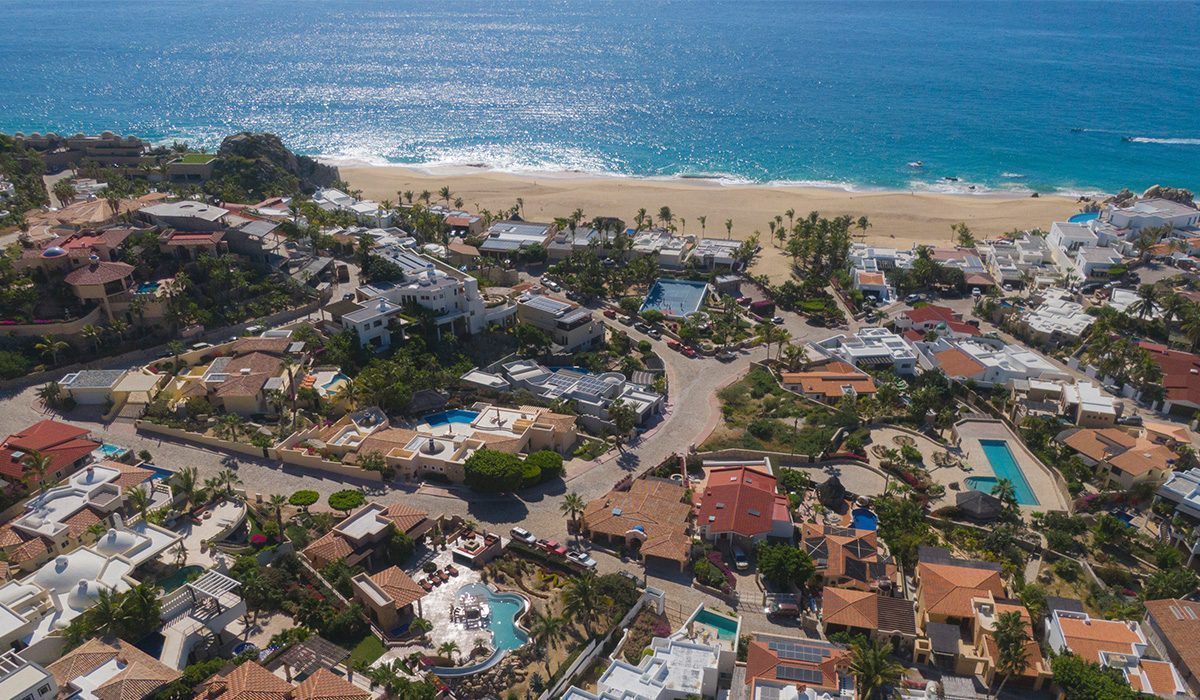
Let me start with the number everyone asks about first. In Q2 2026, Los Cabos luxury condominiums averaged approximately $250-$400 per conditioned square foot, with beachfront villa properties running $800-$1,500 per square foot depending on community. Pedregal and Palmilla beachfront commands the top of that range; mid-corridor communities like Cabo del Sol and Rancho Cerro Colorado sit in the middle.
Dubai's market-wide residential median was AED 1,738 per square foot in the 12 months ending August 2026 — roughly $473 USD at current exchange rates, according to Engel & Völkers Dubai. Prime areas push higher: Palm Jumeirah averages around AED 2,800-3,600/sqft ($760-$980 USD), while Emaar Beachfront hit a median of AED 3,639/sqft (~$990 USD).
At the mid-luxury tier — the $500K to $2M range where most American buyers operate — Cabo delivers 30-50% more space per dollar. A $1 million budget buys a well-located two-bedroom condo with ocean views in Chileno Bay or a three-bedroom villa in Querencia. That same million in Dubai buys a one- or two-bedroom apartment in a prime tower. At the ultra-luxury tier above $5M, the gap narrows — Pedregal beachfront and Palm Jumeirah are in the same ballpark.
Ownership Structure: Freehold vs Fideicomiso
This is where Dubai has a genuine structural advantage. In designated freehold zones (which include all major developments), foreign buyers hold the property deed directly. No intermediary, no trust, no annual bank fees. You buy it, your name goes on the title, done.
In Mexico, foreigners cannot directly own property within 50 kilometers of the coastline. Instead, a Mexican bank holds the property in a fideicomiso (bank trust) on your behalf. You have full rights to use, rent, improve, and sell the property — the trust is a legal mechanism, not a limitation on your ownership rights. But it does add complexity: the trust must be renewed every 50 years, there are annual bank fees of $500-$1,500, and the setup process takes 4-8 weeks during closing.
The fideicomiso is not a dealbreaker — hundreds of thousands of Americans own Mexican coastal property through this structure, and it has been legally tested for decades. But compared to Dubai's simple freehold, it is an additional friction point that adds cost and closing time. I have never had a deal fall apart because of the fideicomiso, but I have had buyers express frustration with the paperwork relative to what they expected.
Tax Comparison
If your primary goal is tax optimization, Dubai wins this category outright.
| Tax Category | Los Cabos | Dubai |
|---|---|---|
| Purchase Transfer Tax | 2-5% (acquisition tax) | 4% (DLD transfer fee) |
| Annual Property Tax | ~0.1-0.3% of assessed value | None (5% municipality fee on rental income only) |
| Rental Income Tax | 25% on gross (non-residents) or 35% on net | 0% |
| Capital Gains Tax | Up to 35% on profit | 0% |
| Fideicomiso / Trust Fees | $500-$1,500/year | N/A |
However — and this is critical — Americans are taxed on worldwide income by the IRS regardless of where the property is located. The US tax obligation applies whether you own in Cabo or Dubai. You can claim foreign tax credits for taxes paid to Mexico, which partially offsets the double taxation. In Dubai, with no local tax to credit, you owe the full US rate on rental income and gains. The net effective difference is smaller than the headline rates suggest, and your CPA should model both scenarios before you decide based on tax alone.
Rental Income: Vacation vs Long-Term
These are fundamentally different rental markets, and the comparison requires understanding the model, not just the yield number.
Dubai is primarily a long-term rental market. The city has a massive expat workforce — over 85% of residents are foreign nationals — creating permanent demand for housing. Average gross rental yields run 5-8% citywide, with well-located studios and one-bedrooms sometimes reaching 8-10%. Vacancy rates are low, turnover is predictable, and management is relatively passive. It is closer to owning rental property in a US city than to the vacation rental model.
Los Cabos is a vacation rental market. Properties earn income through nightly and weekly bookings, primarily from American and Canadian tourists. Gross yields run 4-7% for well-managed luxury properties, with peak-season nightly rates of $300-$1,500+ depending on property type and location. Occupancy averages 55-70% annually for well-marketed properties, with strong seasonality — November through April is peak, summer is slower. Management is more intensive, and your property's success depends heavily on listing quality, reviews, and seasonal pricing strategy.
Dubai gives you steadier, more passive income. Cabo gives you higher per-night rates with more variability and management overhead. For hands-off investors, Dubai is simpler. For owners who use the property themselves and rent during vacant periods, Cabo's model is more natural.
Need a Rental Income Projection?
We model unit-level rental projections for every major Los Cabos community — occupancy, ADR, expenses, and net yield. Get the real numbers before you commit.
Book a Numbers CallLifestyle: Baja vs Gulf
This is where the comparison gets personal, and where I have a clear bias — I chose Cabo.
Los Cabos is a beach town at its core. Desert mountains meet the Sea of Cortez. The pace is slow except during peak tourist season. The food scene is world-class but intimate — you will know the chef at your favorite restaurant by name. The outdoor lifestyle revolves around ocean activities: fishing, surfing, diving, snorkeling, whale watching. The San Jose del Cabo art district, the farm-to-table movement, the hiking in the Sierra de la Laguna — it is a nature-first lifestyle in a setting that still feels authentically Mexican.
Dubai is a megacity. It is architecturally stunning, commercially hyperactive, and logistically impressive. The infrastructure is immaculate. The restaurant scene is global and varied. Shopping is a primary activity. The weather is brutal from May through September (120°F+), which is the inverse of Cabo's mild summer temperatures (85-95°F). The social scene is cosmopolitan and fast — this is not a place that slows down.
For Americans who want a relaxed, outdoor-oriented lifestyle within a short flight from home, Cabo wins. For those who want a global urban experience with a tax advantage and do not mind 15-hour flights, Dubai has appeal. They are not really competing for the same buyer — they are competing for the same investment dollar.
Flight Access: The Proximity Factor
This is Cabo's single biggest practical advantage and it cannot be overstated. SJD airport is a 2-hour-15-minute flight from Los Angeles, 3 hours from Dallas, 2 hours from Phoenix, 3 hours from Denver, and 5.5 hours from New York. There are over 60 nonstop routes from US and Canadian cities as of 2026, with carriers adding capacity every season.
Dubai is 12-16 hours from the US depending on the routing. Direct flights operate from New York (~13 hours), Los Angeles (~16 hours), and a handful of other cities. Everything else requires a connection, typically through London, Frankfurt, or Doha. That is a full travel day each way.
This matters more than most buyers initially think. At 2-3 hours, you can use a Cabo property on a long weekend. You can fly down to check on construction, interview a property manager, or deal with a maintenance issue. At 12-16 hours, every visit is a week-long commitment minimum. For hands-on owners — which most American property buyers are — proximity drives usage, and usage drives satisfaction.
Which Is Right for You?
Choose Cabo if:
- You want to actually use the property regularly (not just invest)
- You prefer a nature-oriented, relaxed lifestyle over urban energy
- Flight proximity matters — you want the ability to visit on a weekend
- You want more space per dollar at the mid-luxury price point
- Your buyer network and resale audience is primarily American/Canadian
Choose Dubai if:
- Tax optimization is a primary goal and you have a CPA who can model the FBAR/FATCA implications
- You want passive, long-term rental income with minimal management
- You value urban infrastructure, global connectivity, and a cosmopolitan social scene
- You are diversifying internationally and want exposure to Middle East/Asia capital flows
- Simpler freehold ownership structure matters to you
Most American buyers I work with who seriously evaluate both end up choosing Cabo, and the deciding factor is almost always the same: proximity. The ability to be there in a few hours, to use the property often, and to manage it without multi-day international trips. A property you actually visit is a property you enjoy. A property you visit once a year is just a line item on a spreadsheet.
Ready to Compare Markets?
We have worked with buyers evaluating Cabo against Dubai, Portugal, Costa Rica, and every other luxury market Americans consider. Let us help you make a data-driven decision.
Get a Custom ComparisonFrequently Asked Questions
Is Cabo or Dubai cheaper per square foot?+
Cabo is significantly cheaper. In Q2 2026, Los Cabos luxury condos averaged approximately $250-$400 per conditioned square foot, while beachfront villas ran $800-$1,500/sqft. Dubai's market-wide median was AED 1,738/sqft (approximately $473 USD), and prime areas like Palm Jumeirah and Downtown ran AED 2,500-3,600/sqft ($680-$980 USD). At the ultra-luxury tier ($5M+), the gap narrows — Cabo's Pedregal and Palmilla beachfront competes with Dubai's Palm Jumeirah on price — but the mid-luxury tier ($500K-$2M) is 30-50% cheaper in Cabo.
Can Americans own property in Dubai?+
Yes. Dubai allows foreign freehold ownership in designated areas, which include most major developments (Palm Jumeirah, Downtown, Dubai Marina, Emirates Hills, etc.). There is no trust structure, no bank intermediary, and no annual renewal — you hold the deed directly. This is simpler than Mexico's fideicomiso (bank trust) system for coastal property, though the fideicomiso is well-established and legally secure. Dubai also offers 99-year leasehold in some areas, which is a different ownership structure — verify freehold status before purchasing.
What are the tax differences between Cabo and Dubai?+
Dubai has no personal income tax, no capital gains tax, and no property tax in the traditional sense — owners pay a one-time 4% transfer fee at purchase and a 5% annual municipality fee on rental income. Mexico charges a 25% flat tax on gross rental income for non-residents (or 35% on net income if you have a fiscal representative), plus a property transfer tax of 2-5% at purchase, annual predial (property tax) of approximately 0.1-0.3% of assessed value, and capital gains tax of up to 35% on profits at sale. For pure tax optimization, Dubai wins decisively. For Americans, however, the IRS taxes worldwide income regardless of where the property is — so the Dubai tax advantage is partially offset by US tax obligations and foreign tax credit calculations.
Which market has better rental yields?+
Both markets deliver strong rental yields but through different models. Dubai average gross rental yields run 5-8% citywide, with studios and one-bedrooms in popular areas sometimes reaching 8-10%. Los Cabos luxury vacation rental yields typically run 4-7% gross for well-managed properties, with peak-season nightly rates of $300-$1,500+ depending on property type. Dubai yields benefit from long-term tenant demand (massive expat workforce), while Cabo yields depend on seasonal vacation rental occupancy (averaging 55-70% for well-marketed properties). Dubai provides steadier cash flow; Cabo provides higher per-night rates with more seasonal variability.
How far is Cabo from the US compared to Dubai?+
Cabo (SJD airport) is a 2-3 hour direct flight from most major US cities — Los Angeles 2h15m, Dallas 3h, Denver 3h, Phoenix 2h, New York 5.5h. Dubai (DXB) is 12-16 hours from the US depending on routing, with direct flights from New York (approximately 13 hours), Los Angeles (approximately 16 hours), and connections from most other cities. For Americans who plan to use the property frequently or manage it hands-on, Cabo's proximity is a massive practical advantage. You can fly down for a long weekend. Dubai requires a week-long trip minimum to justify the travel.
Which market is more liquid for resale?+
Dubai has higher transaction volume and a larger international buyer pool, making it generally more liquid. Dubai recorded over 140,000 residential transactions in the 12 months to August 2026. Los Cabos records roughly 2,000-3,000 residential transactions annually. However, Cabo's buyer pool is heavily American and Canadian, which means the demand driver is simpler to understand — US economic conditions and flight availability. Dubai's buyer pool is global and more diversified, which provides stability but also means competing with capital flows from Russia, India, China, and the UK. For American sellers, Cabo's focused buyer pool can actually be an advantage — your marketing targets are clearer.

Aaron Cuha
Real Estate Advisor & Los Cabos Market Expert
Real estate advisor and founder of Living In Cabo. 15+ years helping families navigate complex real estate decisions. Strategic partner with Ronival — Baja's largest brokerage.