Here is a question nobody was asking five years ago that every second-home buyer is asking now: can I actually insure this property? If you own or are shopping for a mountain home in California, Colorado, Utah, or Wyoming, the answer is increasingly uncertain. Nearly 400,000 California homeowners policies have been canceled since 2021. Colorado mountain communities face non-renewal rates 5-10 times the state average. Meanwhile in Cabo, hurricane insurance costs $800-$2,000 per year and nobody is getting dropped. The insurance math is quietly reshaping where smart money buys second homes.
Key Takeaways
- ✓ 400,000+ California homeowner policies canceled since 2021; FAIR Plan enrollment up 43%
- ✓ Colorado mountain home premiums jumped 150-300% in three years
- ✓ Cabo hurricane insurance: $800-$2,000/year with stable availability
- ✓ 10-year insurance cost gap: $60,000-$100,000 on a $1.5M property
- ✓ Cabo has zero wildfire risk — it is a desert with no wildland-urban interface
Tired of the Insurance Roulette?
Cabo properties come with affordable, available insurance — no FAIR Plan, no non-renewal letters, no annual premium shocks. Let us show you what your budget buys.
Get a Cabo Insurance ComparisonThe Western US Insurance Crisis: By the Numbers
The data is not ambiguous. The Western US is in the middle of a structural repricing of wildfire risk that is making mountain-town homeownership dramatically more expensive — and in some cases, impossible to insure at any price.
California
The January 2025 Palisades and Eaton wildfires — among the most destructive in California history — caused estimated insured losses of $30-50 billion, potentially making them the largest insured loss event in US history. The damage accelerated a crisis that was already building:
- 400,000+ policies canceled since 2021
- FAIR Plan enrollment up 43% in just 15 months (FAIR is the insurer of last resort)
- Seven of California's top 12 insurers have limited new policies or withdrawn renewals
- State Farm's 17% emergency rate increase was approved in March 2026
- Homeowners in fire-prone ZIP codes face 2.8 million non-renewals between 2020 and 2025
Colorado
Colorado's mountain communities are following California's trajectory. The state has experienced a 77% increase in homeowners insurance non-renewals from 2018 through 2023, and the trend has continued into 2025-2026. Communities like Evergreen, Conifer, Nederland, and areas of Boulder County face non-renewal rates 5-10 times higher than the state average. Premiums for mountain homes that previously cost $2,000-$3,000 annually now run $6,000-$12,000.
Utah and Wyoming
Utah's Wasatch Range communities — including the Park City area where I live — are seeing the same pattern emerge. Carriers are beginning to apply wildfire risk scores to mountain properties, and premium increases of 40-80% over two years are common. Wyoming has been less affected so far, but updated catastrophe models are reclassifying risk zones across the intermountain West.
Cabo Insurance: A Different Universe
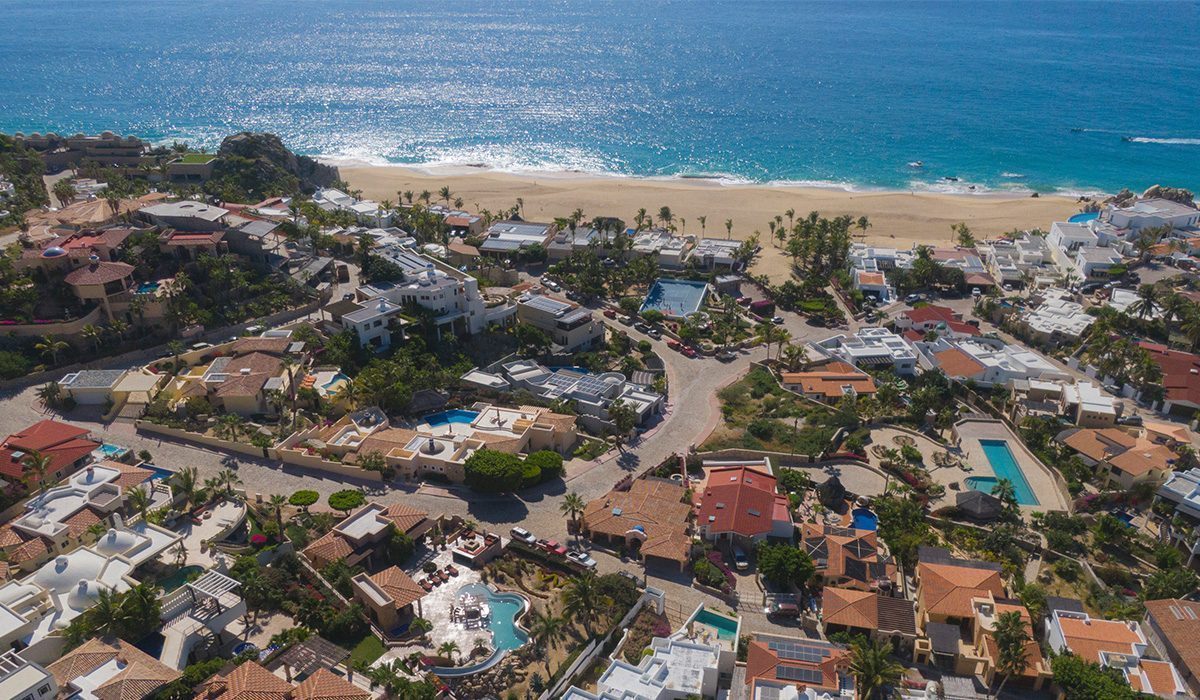
Los Cabos sits on a desert peninsula with virtually zero wildfire risk. There is no wildland-urban interface. The vegetation is sparse desert scrub, not the dense forests and chaparral that fuel Western US fires. The primary natural disaster risk is hurricanes — and the insurance market handles that risk efficiently and affordably.
What Cabo Insurance Actually Costs
- $500,000 property: $400-$800 per year
- $1 million property: $800-$1,500 per year
- $2 million property: $1,200-$2,500 per year
- $5 million+ property: $2,500-$5,000 per year
These premiums include wind, hurricane, earthquake, and standard perils. Flood coverage may require an additional rider depending on elevation and proximity to arroyos. For a complete breakdown, see our property insurance guide.
The Risk in Context
Cabo does face hurricane risk — that is real and should not be dismissed. Hurricane Odile in 2014 was a Category 3 storm that caused significant damage across the peninsula. But the frequency is key: a major hurricane directly impacting Los Cabos occurs approximately once every 10-15 years. Compare that to the annual wildfire threat cycle in California and Colorado, where multiple fires burn thousands of acres every single year.
Modern construction in Cabo's gated communities is engineered for Category 3+ winds. Reinforced concrete, impact-resistant windows, and proper drainage are standard in developments built after 2014 (when Odile exposed construction deficiencies in older buildings). For more on what Odile taught the market, see our hurricane preparation guide.
Need Help Comparing Insurance Costs?
We can connect you with bilingual insurance brokers who specialize in foreign-owned Cabo properties. Get quotes before you buy.
Book a CallThe 10-Year Math
Let us compare total insurance costs on a $1.5 million second home over 10 years:
Western US mountain home: $6,000-$12,000 per year × 10 years = $60,000-$120,000 in insurance premiums. And this assumes you can maintain coverage — if your policy is non-renewed and you end up on a state FAIR Plan, premiums could be even higher with worse coverage.
Cabo gated community: $1,000-$2,000 per year × 10 years = $10,000-$20,000 in insurance premiums. Coverage is stable, readily available from multiple carriers, and has not experienced the structural repricing hitting the Western US.
The difference: $50,000-$100,000 over a decade. That is not a rounding error — it is a meaningful cost advantage that compounds with the already-lower property taxes and maintenance costs in Cabo.
The Availability Problem
Cost is one thing. Availability is another. The most insidious part of the Western US wildfire insurance crisis is not that insurance is expensive — it is that it may become unavailable for your specific property. A non-renewal letter means you are shopping for coverage in a market where carriers are actively reducing exposure. Your options narrow to state FAIR Plans (which offer limited coverage at elevated prices) or surplus lines carriers (which are unregulated and can set any price).
In Cabo, no comparable availability crisis exists. Multiple Mexican carriers (GNP Seguros, Qualitas, AXA Mexico, Chubb Mexico) and US-based providers specializing in Mexico (Mexpro, West Coast Risk Insurance, Baja Bound) compete for foreign homeowner business. Policies are issued in English, claims support is bilingual, and coverage terms are standardized.
How Insurance Is Shifting Second-Home Demand
I am seeing this shift in real time. Buyers who five years ago would have automatically looked at Lake Tahoe, Aspen, Park City, or Telluride for a second home are now asking: what if I bought in Cabo instead? The catalyst is often their insurance renewal letter — a 200% premium increase or a non-renewal notice makes people rethink the math quickly.
The conversation usually goes like this: "I am paying $9,000 a year to insure my Tahoe cabin and my carrier just told me they are not renewing. A Cabo condo at the same price point costs $1,200 a year to insure and I can actually use it more months of the year." The numbers do the selling.
For buyers comparing specific markets, see our detailed comparisons: Cabo vs Scottsdale, Cabo vs Park City, Cabo vs Aspen, and Cabo vs Denver.
The Bottom Line
The Western US wildfire insurance crisis is structural, not cyclical. Climate change, urban sprawl into wildfire-prone areas, and decades of fire suppression have created a risk landscape that the insurance industry is fundamentally repricing. This will not reverse.
Cabo's hurricane risk, by contrast, is well-understood, well-modeled, and well-insured at affordable premiums. The desert environment has zero wildfire risk. Modern construction handles the wind loads. And the insurance market works the way insurance is supposed to work — you pay a reasonable premium, coverage is available, and claims are processed when events occur.
For second-home buyers running the numbers, the insurance gap is becoming one of the most compelling reasons to look south rather than up the mountain.
See the Full Financial Picture
Insurance is just one part of the cost equation. We build complete cost comparisons — purchase price, taxes, insurance, HOA, maintenance, and rental income — for Cabo versus your current market.
Get Your ComparisonFrequently Asked Questions
How much does hurricane insurance cost in Cabo?+
Hurricane insurance for a well-constructed property in a Los Cabos gated community typically costs $800 to $2,000 per year, depending on the property value, construction type, proximity to the ocean, and deductible chosen. Policies are readily available from multiple Mexican carriers (GNP, Qualitas, AXA Mexico) and US-based providers specializing in Mexico (Mexpro, West Coast RI). Coverage includes wind damage, water intrusion, and structural damage from tropical storms.
Is wildfire a risk in Cabo?+
No. The Baja California Sur peninsula is a desert environment with extremely low vegetation density. There is no wildland-urban interface risk comparable to California, Colorado, or Utah mountain communities. The primary natural disaster risk in Los Cabos is hurricanes, which historically directly impact the area approximately once every 10-15 years. Modern construction in gated communities is engineered for Category 3+ winds.
How bad is the California wildfire insurance crisis in 2026?+
Severe. Nearly 400,000 homeowners policies have been canceled since 2021, and California's FAIR Plan (the insurer of last resort) enrollment has swelled by 43% in 15 months. The January 2025 Los Angeles fires caused an estimated $30-50 billion in insured losses. Seven of California's top 12 insurers have limited new policies or withdrawn renewals. State Farm secured a 17% emergency rate increase in March 2026. Homeowners in fire-prone ZIP codes face non-renewal rates dramatically higher than state averages.
What about Colorado mountain home insurance?+
Colorado has experienced a 77% increase in homeowners insurance non-renewals since 2018. Mountain communities like Evergreen, Conifer, and Nederland face non-renewal rates 5-10x higher than state averages. Premiums for mountain homes that previously cost $2,000-$3,000 annually now run $6,000-$12,000. Colorado's HB 25-1182, effective July 2026, requires insurers to disclose wildfire risk scores and factor in mitigation efforts, but the underlying risk repricing is structural.
Does Mexico property insurance cover earthquakes?+
Yes. Most comprehensive Mexican homeowners policies include earthquake coverage as part of the standard policy, not as an expensive add-on as in California. Los Cabos sits in a seismically active zone (the tip of the Baja peninsula), but significant earthquake events are rare. Modern construction codes in Los Cabos require seismic-resistant design, and most luxury developments exceed those requirements.

Aaron Cuha
Real Estate Advisor & Los Cabos Market Expert
Real estate advisor and founder of Living In Cabo. 15+ years helping families navigate complex real estate decisions. Strategic partner with Ronival — Baja's largest brokerage.