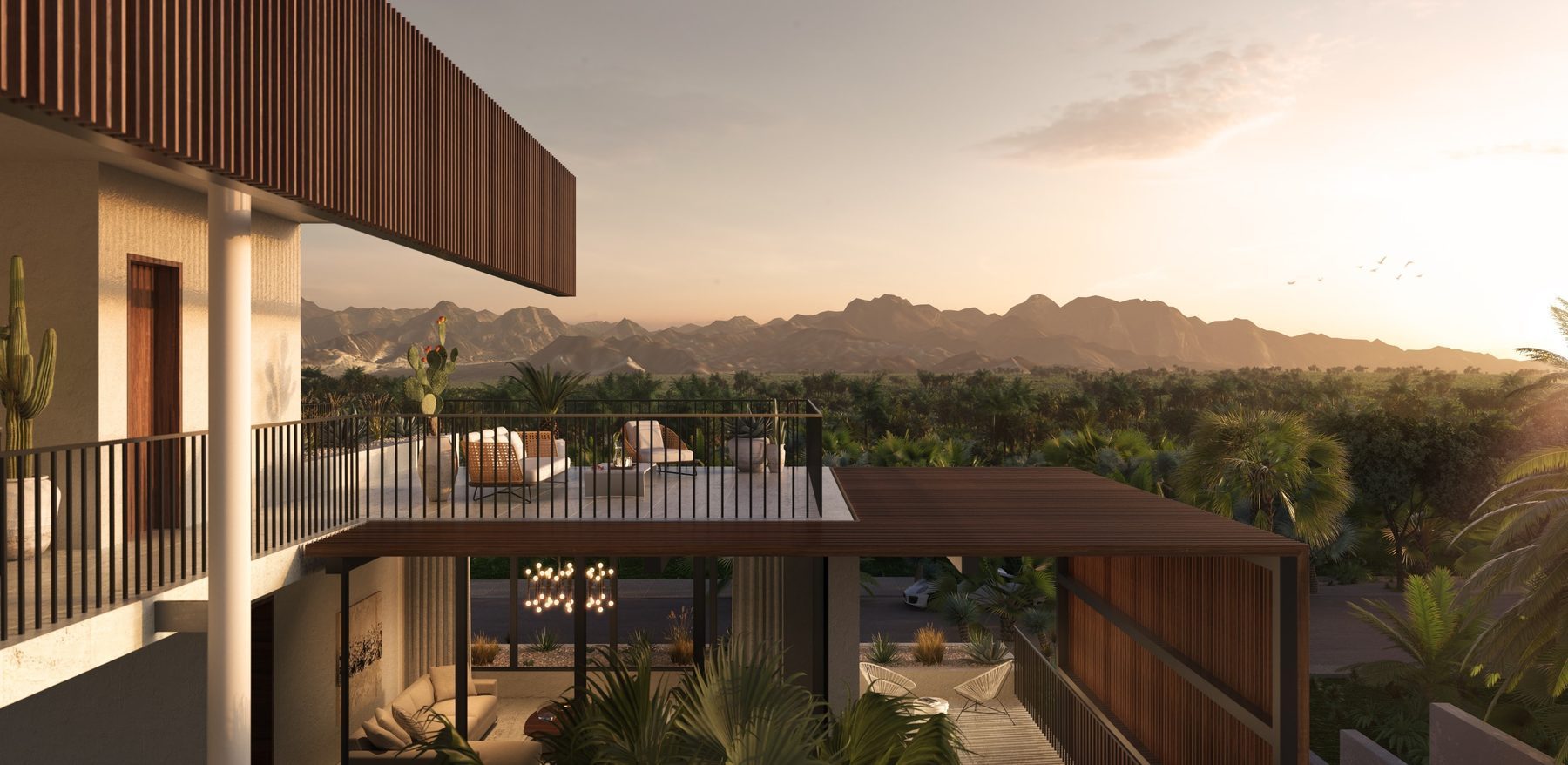
I toured a prefab home in El Pescadero last month that looked better than half the stick-built customs I have seen in Cabo San Lucas. It went up in fourteen weeks. The owner told me it cost $85 per square foot all-in — foundation, structure, finishes, kitchen, bathrooms, AC, everything. That is less than half what a comparable traditional build runs in the Corridor.
And then he told me the rest. He cannot get insurance on it because no Mexican insurer has a category for modular construction. His neighbors in the ejido think it is a shipping container and complained to the delegado. And when he tried to refinance through a Mexican bank, the appraiser had no comparable sales to justify the value.
Welcome to the frontier of Cabo construction. Prefab and modular housing is coming to BCS whether the market is ready or not. Here is what you need to know before you buy or build one.
Key Takeaways
- Prefab/modular construction in BCS costs $60–$120/sqft compared to $120–$200/sqft for traditional concrete block and CMU construction — a 40–50% savings
- Build timelines are 3–5 months versus 10–18 months for comparable traditional builds — the speed advantage is real
- Most gated communities in Los Cabos will not approve prefab or modular structures. HOA architectural committees require traditional masonry construction
- Import duties on prefab components shipped from the US or Canada add 15–25% to the materials cost, partially eroding the price advantage
- The best locations for prefab/modular homes in BCS are the Pacific Side (El Pescadero, Cerritos), the East Cape (Los Barriles, Zacatitos), and rural lots outside gated developments
Considering Alternative Construction?
We help buyers evaluate whether prefab makes sense for their lot, budget, and long-term goals.
Get AdviceWhat Prefab Actually Means in the BCS Context
The term "prefab" in Los Cabos covers several distinct construction methods. They are not interchangeable, and the cost, permitting, and insurance implications differ:
Steel-Frame Modular
Factory-built steel-frame modules assembled on-site. This is the most common prefab method arriving in BCS. The modules are fabricated in factories in Guadalajara, Monterrey, or the US (Arizona and Texas primarily), trucked to the site, and connected on a prepared foundation. Typical module sizes: 12 feet wide × 40–60 feet long (road transport limits).
Cost: $60–$90/sqft for the modules plus $15–$25/sqft for foundation, site prep, connections, and finishing. All-in: $75–$115/sqft.
Container Homes
Converted shipping containers (typically 20-foot or 40-foot ISO containers) modified into living spaces. This is the method that gets the most social media attention and causes the most controversy in BCS.
Cost: $40–$70/sqft for the container conversion plus $20–$30/sqft for foundation, insulation (critical in a desert climate), plumbing, and electrical. All-in: $60–$100/sqft. But — and this is a big but — container homes require extensive insulation and vapor barrier work in Cabo's climate. A steel box in a desert reaches 140°F internal temperature without insulation. The thermal engineering adds $10–$20/sqft that container promoters often omit from their quotes.
Panelized / SIP (Structural Insulated Panel)
Pre-manufactured wall and roof panels assembled on-site on a concrete foundation. The panels arrive flat-packed, which makes shipping from US or Mexican factories more efficient than shipping volumetric modules.
Cost: $70–$110/sqft all-in. The panels themselves are $35–$55/sqft, with the balance going to foundation, assembly, mechanical systems, and finishes.
3D-Printed Concrete
Yes, this exists in Mexico. ICON has printed homes in Tabasco, and smaller operators are experimenting in BCS. The technology is real but not yet practical for custom residential in Los Cabos — the printers require flat terrain, the design options are limited, and there is no local operator with consistent capacity.
Cost: $50–$80/sqft for the printed shell, but total project costs are comparable to traditional once you add roof, mechanical systems, and finishes. The real advantage is speed (walls in 48 hours) rather than cost.
Real Cost Comparison: Prefab vs. Traditional
| Method | Cost/sqft | 1,500 sqft Home | Timeline |
|---|---|---|---|
| Traditional (block/CMU) | $120–$200 | $180K–$300K | 10–18 months |
| Steel-frame modular | $75–$115 | $112K–$172K | 3–5 months |
| Container conversion | $60–$100 | $90K–$150K | 2–4 months |
| Panelized / SIP | $70–$110 | $105K–$165K | 3–5 months |
| 3D-printed concrete | $80–$130 | $120K–$195K | 2–4 months |
The savings are real — 35–50% on a typical 1,500 sqft home. But these numbers do not tell the whole story. Read on before you break out the checkbook.
Import Duties: The Hidden Cost
If your prefab components are manufactured in the US or Canada and shipped to BCS, you will pay Mexican import duties that partially erode the cost advantage:
- Steel structures: 10–15% import duty plus 16% IVA on the duty-inclusive value
- Shipping containers (as building material): 15–20% import duty. Note: containers imported as "cargo containers" have different duty rates than containers imported as "building materials." Classification matters, and getting it wrong can trigger penalties
- SIP panels: 10–12% import duty
- Prefab bathroom/kitchen pods: 15–20% import duty
On a $100,000 materials shipment from Arizona, import duties and IVA add $25,000–$38,000. That reduces the savings from "50% cheaper than traditional" to "25–30% cheaper" — still meaningful, but not the revolution the marketing materials promise.
The workaround: source prefab components from Mexican factories. Mexico's domestic manufacturing of steel-frame modular and panelized systems has grown rapidly. Monterrey and Guadalajara both have factories producing quality prefab components at prices 20–30% below US equivalents, with no import duty. The trade-off is longer lead times (6–10 weeks vs. 3–4 from US factories) and fewer design options.
Where Prefab Actually Works in Los Cabos
Here is the honest answer: prefab homes work in specific locations within BCS, and they are a nonstarter in others.
Where It Works
- El Pescadero / Cerritos: Rural lots with no HOA restrictions. The most active prefab construction zone in BCS right now. Several steel-frame and container homes have been built here in the past two years, and the aesthetic fits the area's surf/bohemian character
- Los Barriles: Similar situation — rural lots, no architectural committee, and a community that values practicality over luxury finishes. Several kite school owners have built container-based structures for operations and housing
- Zacatitos: Raw lots in the East Cape with minimal development restrictions. Good location for a modular home as a base while you decide whether to build traditional later
- Rural ejido land (with proper conversion): Ejido parcels that have been properly privatized through PROCEDE/PROGAN are candidates for prefab, since there is no HOA and municipal oversight is minimal. However, ensure the ejido conversion is complete and legally clean — ejido land issues are the #1 legal problem in BCS real estate
Where It Does Not Work
- Any gated community with an architectural committee. Pedregal, Querencia, Diamante, Palmilla, Chileno Bay, El Dorado, Rancho San Lucas — none of these will approve prefab or container construction. Their architectural guidelines require traditional masonry (block, CMU, or poured concrete). I have not seen a single exception
- Beachfront lots in the federal zone. SEMARNAT environmental permits for coastal construction specify traditional construction methods. Prefab structures in the federal zone face additional regulatory hurdles
- Downtown San Jose del Cabo. The historic district has specific architectural preservation requirements that preclude non-traditional construction
Not Sure If Prefab Is Right for Your Lot?
Book a call and we will evaluate your location, zoning, and HOA restrictions before you commit.
Book a CallThe Insurance Problem
This is the biggest unresolved issue with prefab construction in BCS. Mexican property insurers (GNP, Qualitas, AXA Mexico, Chubb Mexico) classify homes by construction type for underwriting purposes. The categories are:
- Type A: Concrete/masonry (block, CMU, poured concrete) — standard residential rate
- Type B: Mixed construction (concrete foundation with wood or metal framing) — 15–30% premium over Type A
- Type C: Wood frame — 40–60% premium, often declined in coastal areas
Steel-frame modular and container homes do not fit neatly into any category. Some insurers classify them as Type B, others as Type C, and some simply decline coverage. The result is that prefab homeowners in BCS often pay 20–40% more for insurance than traditional homeowners — if they can get coverage at all.
One solution gaining traction: insuring through a US-based international property insurer (Lloyd's of London underwriters, for example) that has more experience with alternative construction methods. The premiums are comparable to Mexican Type A rates, but the claims process is more complex.
Resale Reality Check
The elephant in the room: what happens when you want to sell a prefab home in BCS?
Today, there is no established resale market for prefab homes in Los Cabos. The comparable sales data does not exist because there are too few transactions. A Mexican bank appraiser valuing your prefab home will likely use traditional construction comparables and apply a discount — typically 15–25% — for non-standard construction.
This means your $150,000 prefab home might appraise at $110,000–$127,000 for lending purposes. If your buyer needs Mexican financing, this is a problem.
For cash buyers — which is most of the BCS market for properties under $500K — the appraisal issue is less relevant. The buyer is looking at the property, the location, and the asking price. A well-built, well-finished prefab home in El Pescadero will sell if it is priced competitively. But it will sell for less per square foot than a comparable traditional build.
My honest assessment: if you are building a prefab home in BCS, build it with the assumption that you are holding for 10+ years. The resale market will mature — more prefab homes will be built, comparable sales will accumulate, and insurance and appraisal practices will catch up. But in 2026, you are an early adopter, and early adopters take the risk.
Practical Advice From the Field
- Get your licencia de construcción before ordering modules. Municipal permitting for prefab is the same as for traditional construction — you need a uso de suelo, architectural plans stamped by a licensed architect, and a building permit. The municipality does not care that your walls arrive on a truck; they care that the plans comply with code
- Budget for foundation parity. The foundation for a prefab home is the same as for traditional — concrete slab or grade beams on a prepared site. This is not where you save money. Budget $20–$30/sqft for the foundation regardless of what goes on top
- Insulate aggressively. BCS is a desert. Cabo San Lucas hits 105°F in summer. A steel or container structure without proper insulation is an oven. Budget $12–$20/sqft for insulation, vapor barrier, and thermal breaks. This is non-negotiable
- Use a local contractor for site work and connections. Ship the modules from wherever you like, but hire a local BCS contractor for foundation, utility connections, and finish work. They know the soil, the building codes, and the inspectors
- Document everything for insurance and resale. Photograph every stage of construction. Keep all engineering certifications, material specs, and permit documents. When you sell or insure, you will need to prove the construction quality that a traditional home demonstrates through its materials alone
Exploring Alternative Construction?
We help buyers evaluate whether prefab, modular, or traditional construction is the right fit for their lot, budget, and goals.
Get StartedFrequently Asked Questions
How much does a prefab home cost in Los Cabos?+
A prefab/modular home in Los Cabos costs $60–$120/sqft all-in, compared to $120–$200/sqft for traditional construction. For a 1,500-square-foot home, that is $90,000–$180,000 for prefab versus $180,000–$300,000 for traditional. Steel-frame modular runs $75–$115/sqft, container conversion $60–$100/sqft, and panelized/SIP $70–$110/sqft. If importing from the US, add 15–25% for import duties and IVA.
Can I build a prefab home in a Cabo gated community?+
No. Every major gated community in Los Cabos — Pedregal, Querencia, Diamante, Palmilla, Chileno Bay, El Dorado, Rancho San Lucas — requires traditional masonry construction through their architectural committee. Prefab, modular, and container homes are not approved. Prefab works on rural lots in El Pescadero, Cerritos, Los Barriles, Zacatitos, and other areas without HOA restrictions.
How fast can a prefab home be built in Cabo?+
Steel-frame modular and panelized homes take 3–5 months from foundation to occupancy. Container conversions take 2–4 months. This compares to 10–18 months for traditional construction. Add 6–10 weeks for module fabrication (4–6 from Mexico, 3–4 from US factories) and 4–8 weeks for permitting. Total project timeline: 5–8 months from permitting to occupancy, roughly half of traditional construction.
Can I get insurance on a prefab home in Mexico?+
It is difficult. Mexican insurers classify prefab and container homes as Type B (mixed construction, 15–30% premium) or Type C (non-masonry, 40–60% premium), and some decline coverage entirely. An alternative is insuring through US-based international property insurers such as Lloyd's of London underwriters, which have more experience with alternative construction. Expect to pay 20–40% more than standard residential rates until the Mexican insurance market catches up.
What import duties apply to prefab materials from the US?+
Steel structures face 10–15% import duty plus 16% IVA. Shipping containers imported as building material face 15–20% duty. SIP panels face 10–12% duty. On a $100,000 materials shipment, total duties and IVA add $25,000–$38,000. To avoid duties, source from Mexican factories in Monterrey or Guadalajara — prices are 20–30% below US equivalents with no import duty, but lead times are longer (6–10 weeks).
Do prefab homes in Cabo hold their resale value?+
Currently, there is no established resale market for prefab homes in Los Cabos. Bank appraisers typically apply a 15–25% discount versus traditional construction comparables. For cash buyers, a well-built prefab in El Pescadero or Los Barriles will sell at a competitive price, but at a lower per-square-foot value than traditional. If you are building prefab, plan for a 10+ year hold — the resale market will mature as more prefab homes are built and comparable sales accumulate.
Where is the best location for a prefab home near Cabo?+
El Pescadero and Cerritos on the Pacific Side are the most active prefab construction areas in BCS — rural lots with no HOA restrictions and a community that embraces alternative construction. Los Barriles and Zacatitos on the East Cape are also strong candidates. Entry prices for lots range from $30,000–$150,000. Avoid gated communities (all prohibit prefab), beachfront federal zone lots (SEMARNAT restrictions), and downtown San Jose del Cabo (historic preservation rules).
Do I need a building permit for a prefab home in Mexico?+
Yes. The permitting process is identical to traditional construction: uso de suelo verification, architectural plans from a licensed Mexican architect, and a licencia de construcción from the municipality. The municipality does not differentiate between prefab and traditional — they review plans for code compliance regardless of construction method. Budget $5,500–$15,500 for permits and professional fees, and 8–16 weeks for the permitting process.

Aaron Cuha
Real Estate Advisor & Los Cabos Market Expert
Real estate advisor and founder of Living In Cabo. 15+ years helping families navigate complex real estate decisions. Strategic partner with Ronival — Baja's largest brokerage.